Hey,
This is a bit strange and off-topic, but thought I'd mention it. The Jack Rabbit Slims diner clip from Pulp Fiction Nabeel screened in the compilation scores lecture on nostalgia and pastiche in Boogie Nights reminded me of a 1995 Farmers (Where the Price is Right! Strange, I know) catalogue I discovered a few years back among some papers. From memory, the clothing section had these photographs of girls and guys modeling casual denim and cotton mid-nineties gear in a simulated diner setting, with the '40s Wurlitzer jukebox and art-deco and kitschy '50s and '60s background decor straight out of the Pulp Fiction scene. I thought it was pretty interesting that a film's style impacted on fashion trends here in New Zealand. It's also a kind of reversal of the mainstreaming of a subculture's style from the screen to the 'street'. I think there's an actual Jack Rabbit Slims somewhere in Europe in the style of the diner in the ref-laden, intertextual-heavy clip. As the all of the earlier posts mention, the paradoxical nature of a subculture's dual existence both within and against the mainstream and the 'poser' movement can be tied back to the malleable nature of a subculture's attitude and style. I agree with the idea that the reduction and repackaging of the punk attitude and musical style to a series of images, a collection of signs, and a few icons works to obscure its 'authentic' roots. Even the Teds of the '50s (lower class rebel-types affecting a kind of distorted middle-class Edwardian appearance), or the rockers of the '60s can be linked with punk or even hip-hop in that they share a similar social-political-musical reaction against the mainstream, and the original desire to effect a kind of social change through music. But as mentioned in the earlier posts, when a newly-commodified subculture is made accessible through music and fashion, a middle-class kid in dire need of street cred can easily fashion themselves into the likeness of the artist onscreen. Often a subculture knowingly constructs itself from recognisable commodities, and I think that's where the 'underground' anticipates the mainstream's interest. I guess a listener's genuine identification with the lyrics or claim on a style outside of their background adds to the tricky nature of musical subcultures. Anyone else remember any transfers of a subculture to the screen or from the screen to popular culture? I might have a look for that catalogue again.
Stella
Monday, May 14, 2007

Punk themes... revisted?

I'm going to talk about something a little bit different then punk specifically, but I'm hoping it will still be interesting and critical enough to be of use to the class and my grade; I was astounded when I noticed this.
During the entire punk lecture about punk clothing, fashion and visual art, I couldn't help but think about New Zealand in a similar way. Historically, Punk subculture was meant to show a distinct style and basically gives a big "F* You!" to commercialism and conformism.
I am an exchange student from America, so that is why I noticed this, whereas someone else from here might not. From the very first days I was here, I noticed one thing immediately, and it was glaringly apparent: style.
In America, style is extremely commercialized. From the average school, literally 90% of my peers all wear similar clothes that fall into a variety of 'stereotypical' clothing sets.
-Abercrombie & Fitch/American Eagle type "preppy" clothes.
-Outdoorsy North Face style clothes.
-Plain clothes or cheap clothes from Walmart or department stores.
In America, there is another group which tries to be "thrifty" or "stylized" with their clothes, whether it be retro, odd t-shirts, tight clothes, clashing colors, layers and so on. The ironic thing is that even THIS is commercialized; stores like Urban Outfitters sell many of the same 'retro' items over and over to kids in the same 'group.'
Many people also share extremely similar hairstyles, shoes, and accessories.
On the other hand, when I came to New Zealand, I was absolutely astounded at the styles, even the wild punk-like haircuts. Every day I see people expressing themselves in completely new ways which don't conform to any pattern or fit scheme. There are mixtures of many different clothing styles all in one outfit; I saw a pair of gold-plated Harley-Davidson high tops the other day worn by a girl who also had on a shirt with little candy bars on it. The funny thing is, it looked 'normal.' It fit her style, and i thought it was cool. In America, if anyone tried to do this, they would be automatically cast into the "Dungeons and Dragons weirdos" stereotype category. I have also seen many people with full-fledged mohawks or mullets which I would never seen in the states.
I think in a way this could be seen as an extension of what the punks hoped to achieve: basing ones own preference not on a commercialized, rigid pattern that someone must "fit into," but rather by completely choosing what one wants to wear or express (clothing, hairstyle, visual appearance). Many people have already addressed punk style in the blog, so I offered this slightly-off-topic post in hopes of providing a culturally different point of view.
from the sex pistols punk era film i got the gist that they weren't punk, punk was the name for the copycat genre, calling them punk and grouping them mainstream with the multiple punk bands, fashion, the whole era.whereas those few who started it, i believe, didnt do it to fit in or go with a trend but to shock and offend and be brutally infamous musicians. I wonder if emo is this new punk, and whoever broke it out scorns the term 'emo' and the millions of minions who follow suit. your not original.
music - his and hers, then and now
HI all
Just a bit of personal reflection on the lecture that dealt with the record as a playback apparatus. Certainly the different approaches to music appreciation bewteen the sexes was not something new to me but brought it home all the more. (please note this is purely generalisation. If you fall outside this, this is in no means intended to offend).
Personally I am one who listens to all genres of music and enjoys the feel of the music/song. Dont ask me what my favourite band is, or my favourite music style, or my favourite artist because I couldnt tell you. Music affects me in a very emotional way and I know this to be true of many other people. By contrast play a song to a male aquaintance of mine and he will tell you the name of the band, the name of the song and the year it was released as well as other pieces of related information. He does enhoy the music just as much as I do, but part of this enjoyment comes from hisability to identify what he is listening to, and sharing (and showing off) this knowledge.
In terms of playback apparatus, it seems as if the ipod and MP3 format has de-gendered the issue of music collection somewhat. While people may still know facts about the music at hand, there is no longer the collector's interest as found with records. the playback devices have lost that collectible association. They are simply a smidgen on a computer (to be very technical), not something that can be collected for their own value, as well as the value of the music conatined on it. In an odd juxtaposition of times, the Beatles song Hard Days Night, played on an ipod totally disrupts its position in time and space. And this seems to bring home the issue of the current playback technology. it arrives to the listener without all the cultural baggage as would previously been attributed to it by its format.
Just a thought
Kate vN
Just a bit of personal reflection on the lecture that dealt with the record as a playback apparatus. Certainly the different approaches to music appreciation bewteen the sexes was not something new to me but brought it home all the more. (please note this is purely generalisation. If you fall outside this, this is in no means intended to offend).
Personally I am one who listens to all genres of music and enjoys the feel of the music/song. Dont ask me what my favourite band is, or my favourite music style, or my favourite artist because I couldnt tell you. Music affects me in a very emotional way and I know this to be true of many other people. By contrast play a song to a male aquaintance of mine and he will tell you the name of the band, the name of the song and the year it was released as well as other pieces of related information. He does enhoy the music just as much as I do, but part of this enjoyment comes from hisability to identify what he is listening to, and sharing (and showing off) this knowledge.
In terms of playback apparatus, it seems as if the ipod and MP3 format has de-gendered the issue of music collection somewhat. While people may still know facts about the music at hand, there is no longer the collector's interest as found with records. the playback devices have lost that collectible association. They are simply a smidgen on a computer (to be very technical), not something that can be collected for their own value, as well as the value of the music conatined on it. In an odd juxtaposition of times, the Beatles song Hard Days Night, played on an ipod totally disrupts its position in time and space. And this seems to bring home the issue of the current playback technology. it arrives to the listener without all the cultural baggage as would previously been attributed to it by its format.
Just a thought
Kate vN
Contradiction of Punk Fashion
I find the contradictions inherent in punk fashion very interesting, as there appears to be an irresolvable struggle between the desire to be original and not conform and the nature of following a trend. Punk fashion seems to be an attempt to come across as authentic and original despite it’s very constructed and trend following nature. The ripped clothes adorned with safety clips at first glance portray an uncared for aesthetic. While on one level these fashion choices promote the idea of not caring or conforming to mainstream fashion they are nonetheless a fashion choice. Wearers of punk fashion consciously construct what they feel is an oppositional image and in doing so they follow an already formed trend. I find it interesting that even punk fashion, which was born out of the desire not to conform, ends up becoming a kind of uniform. The very fact that safety pins and ripped clothes can be labeled punk fashion works to show that these fashion choices aren’t original; a significant group of people have embraced these choices in order to belong to the social group of what it means to be Punk. While the very first people to make these fashion choices were original and non-conformist the large group to follow seems to take away from this originality. Clothing choices, which would once have considered to be non-conformist and transgressive, are now less so. While wearers of punk fashion are still not mainstream their fashion has become a kind of uniform.
Hard Days Night
I found the tension between what’s real and fake in ‘ A Hard Days Night,’ very interesting. While much of the film comes across as a realistic documentary it is important to be aware of the very constructed nature of the narrative as a whole and even the characters in it. At the beginning of the film one of the first stylistic choices as was aware of was the use of black and white. This choice had the effect of making the film seem more realistic despite the fact that colour is obviously a closer representation of the real world we live in. It is interesting that what we view as being real or at least more believably real is often a stylistic choice, which is in fact very constructed. There is also a feeling of a lack of real narrative drive in the film, which also adds to the viewer’s sense that the film is ‘real’ documentary, as it does not follow general Hollywood narrative structures. The characters of the Beatles extend this documentary feel even further as they are (supposedly) playing themselves and their dialogue and mannerisms seem unscripted and genuine.
Despite these realistic features of the film it is after all a film and is specifically crafted to have this effect. It’s interesting to think that despite the fact that they band members are playing themselves they are at the same time acting a personae. Even more interesting to think that these individual [personas created by a writer were so convincing that they became to the viewers mind the personalities of the real life band members. The constructed nature of the film is perhaps most evident when the Beatles break into song for little apparent reason. In these parts the film loses some of it’s documentary like feeling and follows more closely to the genre of the musical. Overall the confusion between what’s real and what isn’t makes for a thought provoking watch.
Despite these realistic features of the film it is after all a film and is specifically crafted to have this effect. It’s interesting to think that despite the fact that they band members are playing themselves they are at the same time acting a personae. Even more interesting to think that these individual [personas created by a writer were so convincing that they became to the viewers mind the personalities of the real life band members. The constructed nature of the film is perhaps most evident when the Beatles break into song for little apparent reason. In these parts the film loses some of it’s documentary like feeling and follows more closely to the genre of the musical. Overall the confusion between what’s real and what isn’t makes for a thought provoking watch.
Roll Call and Admin once again.
An increasing number of people have completed their five-post-in-five-different-week minimum, which is excellent. Posting more than the minimum is still a good idea, since it gives you a wider choice to pick from when you submit at the end.
However, an increasing number are also falling off the bandwagon, and now don't have enough time to make five different posts in five different weeks, which will lose you some marks. If you're in this boat, don't panic: it's still worth submitting five posts by the end.
Since Simon asked, the procedure is that you print out your five different posts (or replies) that you want to submit, with the dates each post was submitted. You hand that in at reception with a cover sheet as if it were an assignment. And no, you don't submit to Turnitin.com.
And we still have some people who I can't account for, although I've addressed one of them below. In any case, the people I can't attach to names at the moment are:
Meil
taratr0n
Madison
Isyana
kchu052
Josh
So if you're one of them, if you could send me an email with who you are, that'd be great. Confirmation that any of these are just sitting in on the blog but aren't sitting the paper would also be appreciated.
- Kevin.
However, an increasing number are also falling off the bandwagon, and now don't have enough time to make five different posts in five different weeks, which will lose you some marks. If you're in this boat, don't panic: it's still worth submitting five posts by the end.
Since Simon asked, the procedure is that you print out your five different posts (or replies) that you want to submit, with the dates each post was submitted. You hand that in at reception with a cover sheet as if it were an assignment. And no, you don't submit to Turnitin.com.
And we still have some people who I can't account for, although I've addressed one of them below. In any case, the people I can't attach to names at the moment are:
Meil
taratr0n
Madison
Isyana
kchu052
Josh
So if you're one of them, if you could send me an email with who you are, that'd be great. Confirmation that any of these are just sitting in on the blog but aren't sitting the paper would also be appreciated.
- Kevin.
Punk and the Emergence of Hardcore
I agree with people when they say that Punk was able to go mainstream because of alternative rock, but that doesn’t mean to say that punk’s underground has fragmented. Punk sub-genres such as Hardcore prospered because of Punks underground. This was due to the birth of Hardcore in the late 1970’s which gradually grew heavier to attract fans of the metal community. The music started from punks who wanted to create a heavier style of punk. The music contained faster tempos, louder beats, and a generally "harder" bass/decibel level and later the use of breakdowns was added by bands like Throwdown and Terror. Pioneers or the genre, include Black Flag, Bad Brains and Minor Threat. I was reminded of Black Flag when I watched Punk Attitude the other day. May people think of Henry Rollins as a solo performer or as a comedian, not many people think of him a member of a pioneering hardcore act. Rollins and the band were renowned for their tireless work in promoting their own concerts and releasing self-financed records. This is a convention that authentic punk artists have always aspired to in order to keep an underground mentality.
It is argued that hardcore punk didn’t just influence hardcore metal. In the early 80’s Thrash and Speed metal bands such as Slayer and even the more traditional metal bands like Metallica made use of hardcore punks drum beats. In our present day, however we are embraced with the mediated imagery of hardcore bands. Hatebreed for example have had solid circulation on MTVs Headbangers Ball. Their music videos capture what hardcore is really about such as the ruthless mosh pits with fans doing what can only be deemed as a Kickboxing/ Kapoeta style dance. Obviously being at a hardcore show is more realistic but it is still interesting how punk discourse is conveyed.
It is argued that hardcore punk didn’t just influence hardcore metal. In the early 80’s Thrash and Speed metal bands such as Slayer and even the more traditional metal bands like Metallica made use of hardcore punks drum beats. In our present day, however we are embraced with the mediated imagery of hardcore bands. Hatebreed for example have had solid circulation on MTVs Headbangers Ball. Their music videos capture what hardcore is really about such as the ruthless mosh pits with fans doing what can only be deemed as a Kickboxing/ Kapoeta style dance. Obviously being at a hardcore show is more realistic but it is still interesting how punk discourse is conveyed.
The only way to respond.
To kchu052.
I don't have your email address, so I can't contact you through normal means.
Please send me an email so that I can discuss your problem with you.
Thanks!
To everyone else, this highlights the necessity of contacting me via email rather than leaving responses in messages on the blog. They do not highlight themselves, and may be missed.
- Kevin.
I don't have your email address, so I can't contact you through normal means.
Please send me an email so that I can discuss your problem with you.
Thanks!
To everyone else, this highlights the necessity of contacting me via email rather than leaving responses in messages on the blog. They do not highlight themselves, and may be missed.
- Kevin.
DON'T. PANIC.
Hi everybody.
I've had a lot of questions regarding the rollover from week to week on the blog.
There is no need to worry. My record-keeping is completely independant of the blog's date-setting, and my records run from Monday to Sunday each week. Providing that you post before 12AM Monday morning, you're in the previous week.
If you have technical problems preventing you from doing this when you post on a Sunday night, get back to me so I can take note for record keeping. Generally however, this is also a lesson not to do things on the last minute, although it shouldn't be a cataclysmic disaster if legitimate tech problems get in the way.
Good luck.
- Kevin.
I've had a lot of questions regarding the rollover from week to week on the blog.
There is no need to worry. My record-keeping is completely independant of the blog's date-setting, and my records run from Monday to Sunday each week. Providing that you post before 12AM Monday morning, you're in the previous week.
If you have technical problems preventing you from doing this when you post on a Sunday night, get back to me so I can take note for record keeping. Generally however, this is also a lesson not to do things on the last minute, although it shouldn't be a cataclysmic disaster if legitimate tech problems get in the way.
Good luck.
- Kevin.
The Irony of Punk Culture
After Wednesday's lecture on Punk culture as a movement not only confined to music, I couldn't help but think how ironic and contradictory Punk behaviour has become. It brought to mind Dick Hebdige - a majorly influential figure in terms of subcultures  and namely subcultural resistance. We covered Hebdige extensively in a cultural studies paper I did in first year, and his concepts and theories really made sense to me - possibly because there is just so much evidence of these ideas in our world today. (Hence the name cultural studies, :)
 and namely subcultural resistance. We covered Hebdige extensively in a cultural studies paper I did in first year, and his concepts and theories really made sense to me - possibly because there is just so much evidence of these ideas in our world today. (Hence the name cultural studies, :)
So anyway, the way in which Punk has evolved over the years and constantly reappropriated itself is a perfect example of what Hebdige labels appropriation and reappropriation. Punks today are using symbols and signifiers from the original movement but reappropriating them into their contemporary context. Whether or not this enhances or deteriorates these symbols' authenticity is another interesting debate. However it is very clear that the conflicting processes of assimilation and differentiation are also very relevant in terms of punk culture and its symbols of rebellion.
For example, punk culture deliberately uses subversive behaviour such as juxtaposition and bricolage (tartan, ties, safety pins, etc.) to express a revolt against mainstream society. Yet at the same time, mainstream society is adopting these cultural signs into the discourse of popular fashion. This is evident in the apparent "in-ness" of tartan this season. Yuck...but that's just my personal view. Haha. So there is huge irony in the fact that punks are trying to rebel against the system, while at the same time preaching themselves that it is more the feeling of belonging to a community and the affiliation they feel with fellow punks that distinguishes their style. Hmm.. Interesting. I see that many people have commented on this irony already, but just wanted to add my 5cents. Sorry, 10 cents. I forget those little tuatara fellows are no longer legal tender.
Cheers..
Blinded by the lights: The visual show
A live performance of a prominent band is an audio visual feast, or at least you should expect as much. Most big bands have impressive lighting rigs that work in conjunction with the music to enhance the emotive qualities that the music provides. I like to liken the effects the lighting produces to the similar effects that you get in films with shot size and cutting pace etc.


The amount and colour of light can (in my mind) greatly affect the feel of a piece in regards to whether its a 'happy' or a 'sad' song etc, while rapid lighting changes or strobe lights can 'pump up' the energy of a performance. This use of light does vary in the degree of which it is used in that some bands do not make elaborate setups and instead use subtlety and simplicity to act as a reinforcer to the music, while other bands go all out and bombard the audience with a light show that is almost a stand alone attraction (many acts from the Boiler Room at Big Day Out would perhaps fit this description).
Some, perhaps more eclectic, acts go even further and use their light show to reduce the presence of the band as people; in effect taking over the position as the primary visual element of the performance. One such band is To ol, who employ huge projection screens and extremely minimal lighting on the band (with none at all directed at the vocalist) to push the focus away from them and the 'star' attraction (that is an obvious component of any show for a big name) and bring it to the music itself. The visuals the band uses feel like they have been spawned by the music itself; as if the screens were a picture of someones imagination while listening. The effect is both intriguing and refreshing in contrast to the (sometimes) attention seeking displays that other acts put on.
Tool's reluctance to present the members of the band as an image conjures an interesting question: is the purpose of a live concert to experience the music or to just see the band members in the flesh. I suspect that different people would argue vigorously for either case, but I feel the answer is in fact both. Hearing the live show isn't the same as listening to a CD, nor should it be (what's the point in going, eh?), and I know that I definitly gain satisfaction by watching the musicians themselves performing their work. Having said that I think that going to a concert to just 'see' the band is a little strange (like the Beatles shows where the music was totally drowned out by the audience screaming) and I think it's important that both the visuals and the audio work together to enhance the total experience.
Some, perhaps more eclectic, acts go even further and use their light show to reduce the presence of the band as people; in effect taking over the position as the primary visual element of the performance. One such band is To
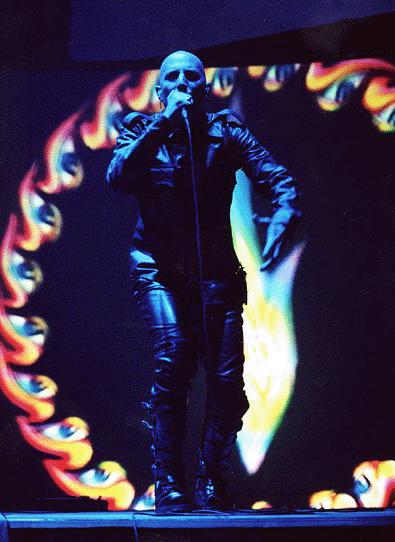 ol, who employ huge projection screens and extremely minimal lighting on the band (with none at all directed at the vocalist) to push the focus away from them and the 'star' attraction (that is an obvious component of any show for a big name) and bring it to the music itself. The visuals the band uses feel like they have been spawned by the music itself; as if the screens were a picture of someones imagination while listening. The effect is both intriguing and refreshing in contrast to the (sometimes) attention seeking displays that other acts put on.
Tool's reluctance to present the members of the band as an image conjures an interesting question: is the purpose of a live concert to experience the music or to just see the band members in the flesh. I suspect that different people would argue vigorously for either case, but I feel the answer is in fact both. Hearing the live show isn't the same as listening to a CD, nor should it be (what's the point in going, eh?), and I know that I definitly gain satisfaction by watching the musicians themselves performing their work. Having said that I think that going to a concert to just 'see' the band is a little strange (like the Beatles shows where the music was totally drowned out by the audience screaming) and I think it's important that both the visuals and the audio work together to enhance the total experience.
Punk & fashion
I’ve always thought of the ‘punk’ movement as primarily being about the musical genre and it was interesting in Wednesday’s lecture to hear about its extremely strong visual culture. There seems to have been quite a bit of discussion in the entries below about the irony of this anti-establishment and anti-consumerist movement being commercialized, and looking at some of the images Nabeel showed it was striking to see just how much effect punk visual culture has had on mainstream fashion. Although the more hard-core aspects of ‘Punk fashion’ such as bondage pants, dog collars or unnatural-colored hair are only worn by ‘alternative’ groups and are easy to distinguish from the mainstream, other things like safety pins, ripped clothing, confrontational slogans and even rubbish bags have been absorbed into mainstream fashion to such an extent that it becomes difficult to distinguish them as ‘punk’.
The first thing that comes to mind is the safety-pin dress worn by Liz Hurley in 1994. This dress, as well as having the distinction (?) of launching Hurley’s career, is generally agreed upon as the thing Versace (one of the most high-profile fashion labels in the world) is best known for. As for ripped clothing, it was only a couple of years ago that the trend for ‘frayed edges’ was so big it was getting really hard in some stores to find anything with a proper hemline. Fashion icon Kate Moss (whose recent collection for Topshop had punters queuing for hours outside their London store) must have hundreds of pairs of cut-off jean shorts.
Speaking of celebrities ‘designing’ for high-street stores, Lily Allen (whose collection for New Look has just been released) is known for her tendency to pair prom-style dresses with sneakers. This style has a strong punk influence- according to Wikipedia, “many female punks rebelled against the stereotypical image of a woman by combining clothes that were delicate or pretty with clothes that were considered masculine, such as combining a ballet tutu with big, clunky boots.”
In today’s issue of ‘Sunday’ (the Sunday Star-Times magazine), there is a large picture of Moss carrying her black vinyl Chanel Coco Cabas (apparently an ‘it’ bag for the 2006-2007 season). The article helpfully points out that this bag has been likened “by more than one observer” to a rubbish bag. I saw a picture in a magazine recently of a fashion-conscious celebrity (I can’t remember who) wearing a shiny black coat, and again the caption mentioned a striking resemblance to a rubbish bag. I was also very pleased to see some shapeless shiny-looking black coats when I was in town yesterday. They are for sale in the Calvin Klein store on High Street if anyone is interested.
The first thing that comes to mind is the safety-pin dress worn by Liz Hurley in 1994. This dress, as well as having the distinction (?) of launching Hurley’s career, is generally agreed upon as the thing Versace (one of the most high-profile fashion labels in the world) is best known for. As for ripped clothing, it was only a couple of years ago that the trend for ‘frayed edges’ was so big it was getting really hard in some stores to find anything with a proper hemline. Fashion icon Kate Moss (whose recent collection for Topshop had punters queuing for hours outside their London store) must have hundreds of pairs of cut-off jean shorts.
Speaking of celebrities ‘designing’ for high-street stores, Lily Allen (whose collection for New Look has just been released) is known for her tendency to pair prom-style dresses with sneakers. This style has a strong punk influence- according to Wikipedia, “many female punks rebelled against the stereotypical image of a woman by combining clothes that were delicate or pretty with clothes that were considered masculine, such as combining a ballet tutu with big, clunky boots.”
In today’s issue of ‘Sunday’ (the Sunday Star-Times magazine), there is a large picture of Moss carrying her black vinyl Chanel Coco Cabas (apparently an ‘it’ bag for the 2006-2007 season). The article helpfully points out that this bag has been likened “by more than one observer” to a rubbish bag. I saw a picture in a magazine recently of a fashion-conscious celebrity (I can’t remember who) wearing a shiny black coat, and again the caption mentioned a striking resemblance to a rubbish bag. I was also very pleased to see some shapeless shiny-looking black coats when I was in town yesterday. They are for sale in the Calvin Klein store on High Street if anyone is interested.
Sunday, May 13, 2007
Sex, drugs and ?: Is Sid Vicious punk?
Perhaps no individual personifies the punk music scene of the late 1970’s better than Sex Pistol’s ‘bassist’ Sid Vicious. Vicious, I believe, has attained a mythologised pop-culture status as punks music's James Dean, Marilyn Monroe or Jim Morrison and is perhaps the most universally conceived perception of Punk music. Yet, compared to his contemporaries, Vicious contributed virtually nothing to the musicality of punk (if you watch his live performances his bass is quite often turned off), and never actually recorded with the Sex Pistol’s. So how and why did Vicious become the cult figurehead of punk musical expression?
Vicious was a close friend of Johnny Rotten and joined the band as original bassist Glen Matlock’s replacement in 1977. His introduction to the band contributed The Sex Pistol’s music becoming secondary to image and sensationalism and resulted in their eventual break-up in 1978. Rotten’s closing statement of their final concert: "Ever get the feeling you've been cheated?" signaling the band’s, and possibly punk music’s demise. So what of Sid Vicious, the personification of punk music - the ultimate rock n roll cliché, without the rock and roll? I think it was Malcom McLaren who said: "if Rotten is the voice of punk, then Vicious is the attitude". But is Vicious not a product of media constructed characterisations of the punk music scene placed on stage with punk’s then most commercially successful band as a bizarre form of performance art in antagonism to punk music ideals? Is Vicious not a poster boy from the establishment for the anti-establishment? Is Vicious as Rotten defined "a follower, not a leade"r and the ultimate Sex Pistol’s fan? Is this really the attitude of punk music?
Vicious was a close friend of Johnny Rotten and joined the band as original bassist Glen Matlock’s replacement in 1977. His introduction to the band contributed The Sex Pistol’s music becoming secondary to image and sensationalism and resulted in their eventual break-up in 1978. Rotten’s closing statement of their final concert: "Ever get the feeling you've been cheated?" signaling the band’s, and possibly punk music’s demise. So what of Sid Vicious, the personification of punk music - the ultimate rock n roll cliché, without the rock and roll? I think it was Malcom McLaren who said: "if Rotten is the voice of punk, then Vicious is the attitude". But is Vicious not a product of media constructed characterisations of the punk music scene placed on stage with punk’s then most commercially successful band as a bizarre form of performance art in antagonism to punk music ideals? Is Vicious not a poster boy from the establishment for the anti-establishment? Is Vicious as Rotten defined "a follower, not a leade"r and the ultimate Sex Pistol’s fan? Is this really the attitude of punk music?
The CD and Cassette - Left out in the cold
In the reading, “Vinyl Communion: The Record as Ritual Object in Girls’ Rites-of-Passage Films”, Robynn J. Stilwell states that, in film, “Digitally encoded CD’s have yet to achieve the same narrative resonance as the record” (page 158). Records have often been the centre of numerous films, such as Ghost World, but the CD, and even the cassette tape, are left in the cold.
A reason for the absence of the CD in film could be because it is the dominant means of (material) music distribution. CD’s potentially loose some of their prestige because of their commonness and mass production, as opposed to the record which is rarer in the 21st century. Also, the characters in films that collect records, such as
As the popularity of music downloading increases, the CD could find itself becoming as rare as the record. Despite this, it still remains to be seen whether the CD will take on the significance the record achieves presently through film, in the future.
Stilwell, Robynn J, “Vinyl Communion: The Record as Ritual Object in Girls’ Rites-of-Passage Films” in Phil Powrie & Robynn Stilwell (eds.) Changing Tunes: The Use of Pre-existing Music in Film.
Popular Producers on Screen
As more and more music videos appear on our televisions its not just the music artist displayed dancing and singing around on the screen. Sometimes there’ll be a cameo or a shot of another artist, be it musical or movie or both. However, highlighted with the star image of Timbaland, more producers are putting themselves in music videos and are now known more for their involvement leading to the success of a song they helped create.
Recently Nelly Furtado has released a flurry of pop hits from Promiscuous Girl to All Good Things. Timbaland has been her main record producer and due to his input it has allowed her to tremendously kick-start her music career in the industry again. Timbaland has also worked with artists such as Justin Timberlake, Jay-Z, Aaliyah and Missy Elliot and has helped them achieve successes in their songs and albums.
The inclusion of a high-profile, widely-recognised producer has helped both the producer and the musician alike. It has allowed Timbaland to release his own album (Shock Value) with collaborations with other artists. Although solo albums of his have been released in the past the presence of him in mainstream music videos has allowed him to market his image and gain more fame. On the other hand, the inclusion of Timbaland in a music video sees him not only as a producer but a musician, performer and an important ‘key’ to the media.
In modern digital music the producer is often the only individual involved in the making of a musical recording, and is in charge for writing, performing, recording and setting up the material. Therefore the term “producer” can really be synonymous with “musician”. This can also be due to the new technological development of music production software allowing entire tracks to be made on a PC or laptop. The old-school use of a team to create a song can now be performed by one individual.
Popular music on screen has allowed more than just the artist to shine through but many others who should really be recognised for their hand in success. Although we often do see producers in music videos they have helped create the image of Timbaland has really shifted the role of producer to a whole new level.
Recently Nelly Furtado has released a flurry of pop hits from Promiscuous Girl to All Good Things. Timbaland has been her main record producer and due to his input it has allowed her to tremendously kick-start her music career in the industry again. Timbaland has also worked with artists such as Justin Timberlake, Jay-Z, Aaliyah and Missy Elliot and has helped them achieve successes in their songs and albums.
The inclusion of a high-profile, widely-recognised producer has helped both the producer and the musician alike. It has allowed Timbaland to release his own album (Shock Value) with collaborations with other artists. Although solo albums of his have been released in the past the presence of him in mainstream music videos has allowed him to market his image and gain more fame. On the other hand, the inclusion of Timbaland in a music video sees him not only as a producer but a musician, performer and an important ‘key’ to the media.
In modern digital music the producer is often the only individual involved in the making of a musical recording, and is in charge for writing, performing, recording and setting up the material. Therefore the term “producer” can really be synonymous with “musician”. This can also be due to the new technological development of music production software allowing entire tracks to be made on a PC or laptop. The old-school use of a team to create a song can now be performed by one individual.
Popular music on screen has allowed more than just the artist to shine through but many others who should really be recognised for their hand in success. Although we often do see producers in music videos they have helped create the image of Timbaland has really shifted the role of producer to a whole new level.
A Sign of the Times
Punk, or more accurately anarchial punk, had very different meanings in the 70s and 80s, these ideas have become ambiguous through being a commerscial tool in our capatilised society. Anarchial punk was about getting thoughts and a message out, the message to be part of a unique subculture that rebelled against the dominant society and government. The fashions they wore, the lyrics in their songs all meant something important to them. The patches often contained their favourite bands and also their political views. Their clothes is what made them part of their particular subculture, it included the people with their 'own kind' and so the music became very important to them. Punk groups like the Sex Pistols has said to in an emotional way declare war on the government, they used their songs and words to speak for them. Their 'fans' or followers were in an agrreance with their music and views and this is how this underground subculture found its way into mainstream society.
Todays punk have in a sense lost this emotional attachment. The lines bewteen music genres have become blurred with the help of the audience, the artists and ofcourse capitalism jumping on the new commercial values. And with this, the fad of emotinal hardcore music and people, and term coined 'emo' emerged. AFI is just one small example of a band that has been said to be one of the origional emo bands, their lead singer being very influential considering the aesthetics to what an emo looks like. The lead singer wears tight fitted clothes, sings about emotional experiences and feelings, makes visible his make-up and most notoriously sports and extremely long one sided fringe. In interviews he has expressed that this is important to him as a sign of abstinence from sex, drugs and alchohol. and so this trend took form into modern society. Clothes companies catching on to their certain dress sense even the makeup they wear. Heavily eye-lined eyes and hair gel and wax have become increasingly bi-gender and this is now miuch more acceptable than a few years ago. Its sad becasue this is purely a fad, a phase in young and impressionable poeples lifes who strive to be part of a subculture. But this new subculture is highly commercial and so they end up conforming to society even more, because as one knows one definition of a subculture is to redefine and amplify the rules of the dominant society. Which in effect looses the importance as to what the anarchial punks stood for. So can they really call themselves emos?? what is the audince emotional about? in myopinion this fad will fade away as soon as the fad steps in, and this is how society shows the change in the times of our society.
Todays punk have in a sense lost this emotional attachment. The lines bewteen music genres have become blurred with the help of the audience, the artists and ofcourse capitalism jumping on the new commercial values. And with this, the fad of emotinal hardcore music and people, and term coined 'emo' emerged. AFI is just one small example of a band that has been said to be one of the origional emo bands, their lead singer being very influential considering the aesthetics to what an emo looks like. The lead singer wears tight fitted clothes, sings about emotional experiences and feelings, makes visible his make-up and most notoriously sports and extremely long one sided fringe. In interviews he has expressed that this is important to him as a sign of abstinence from sex, drugs and alchohol. and so this trend took form into modern society. Clothes companies catching on to their certain dress sense even the makeup they wear. Heavily eye-lined eyes and hair gel and wax have become increasingly bi-gender and this is now miuch more acceptable than a few years ago. Its sad becasue this is purely a fad, a phase in young and impressionable poeples lifes who strive to be part of a subculture. But this new subculture is highly commercial and so they end up conforming to society even more, because as one knows one definition of a subculture is to redefine and amplify the rules of the dominant society. Which in effect looses the importance as to what the anarchial punks stood for. So can they really call themselves emos?? what is the audince emotional about? in myopinion this fad will fade away as soon as the fad steps in, and this is how society shows the change in the times of our society.
You Are.
I’ve noticed over the past week, posts on the blog have continually questioned the authenticity of punk as a culture in its own right. Essentially I can see why people can have those opinions without having a love for the music; (and it seems that is these opinions which have been the main judgement on the scene since its birth), I can tell the cynical that the culture of punk holds more to it than the rough exterior which meets the eye. While my explanation is admittedly (and embarrassingly) new age, I really believe that the punk scene is driven by the spirit which has characterised it and its followers since its conception in the ‘70’s.
Although by today’s standards, differences within the scene make it difficult to determine exactly what a punk is; I feel it can’t be as simple as having a single generic term defining something so unique. After all, any persons attachment to a scene is as individual as people themselves. Being a punk moves far beyond that of wearing your identity on your sleeve and buying into the physical ‘look’ of the scene, if anything I’d say it opposes the collective fashion which has developed in its honour. Instead, defining yourself as a punk is a personal realisation that you stand for whatever you believe the scene represents; whether or not that fits with the traditional stereotypes and politics which have restrained the culture in the past.
Ending on that note, check out the lyrics of the first verse and chorus to The Unseen’s song ‘Something to Say’ (http://www.sing365.com/music/lyric.nsf/Something-To-Say-lyrics-The-Unseen/D21EC4E043BBF0FB48256C960022B026), if you want to try and make sense of my inspiration for this post, however random the connection may be.
:)
Although by today’s standards, differences within the scene make it difficult to determine exactly what a punk is; I feel it can’t be as simple as having a single generic term defining something so unique. After all, any persons attachment to a scene is as individual as people themselves. Being a punk moves far beyond that of wearing your identity on your sleeve and buying into the physical ‘look’ of the scene, if anything I’d say it opposes the collective fashion which has developed in its honour. Instead, defining yourself as a punk is a personal realisation that you stand for whatever you believe the scene represents; whether or not that fits with the traditional stereotypes and politics which have restrained the culture in the past.
Ending on that note, check out the lyrics of the first verse and chorus to The Unseen’s song ‘Something to Say’ (http://www.sing365.com/music/lyric.nsf/Something-To-Say-lyrics-The-Unseen/D21EC4E043BBF0FB48256C960022B026), if you want to try and make sense of my inspiration for this post, however random the connection may be.
:)
Gotta Catch 'Em All!
Someone alluded to the pokérap in an earlier blog, which sent me on a search of youtube and got me thinking. The pokérap represents an insidious use of music in television that borders upon subliminal messaging.
The pokérap played at the end of every episode of the Pokemon cartoon, it’s unrelated to the plot of the show and is simply a very rapid run through of all the pokémon available in the game. It would take five days (or Monday to Friday) to cover all 150 original Pokemon.
Essentially the ‘rapper’ would call at the name of a pokémon and that pokémon’s image would flash on screen with its name in big bold letters below it. Thirty or so pokémon would fly past in about 40 seconds interspersed with the words “Gotta catch ‘em all!” which were likewise flashed onscreen in a bold font.
The catchy tune and innocent nature of the rap hides the fact that it’s encouraging young children to memorize all 150 characters; furthermore, it encourages them to need them, to want them, to ‘catch them’. On one level this encourages a child to play the game more (and catch all the pokémon) but when the pokémon began to be sold as toys it encouraged children to want all of those as well. Essentially, it ensured that rather than just knowing (and wanting) a handful of the total pokémon, children would instead know and want each and every one.
Thus the use of music in this setting is not to aid the plot or set the atmosphere (as in many television shows) but rather to provide a way to educate children about what was essentially a product.
The pokérap played at the end of every episode of the Pokemon cartoon, it’s unrelated to the plot of the show and is simply a very rapid run through of all the pokémon available in the game. It would take five days (or Monday to Friday) to cover all 150 original Pokemon.
Essentially the ‘rapper’ would call at the name of a pokémon and that pokémon’s image would flash on screen with its name in big bold letters below it. Thirty or so pokémon would fly past in about 40 seconds interspersed with the words “Gotta catch ‘em all!” which were likewise flashed onscreen in a bold font.
The catchy tune and innocent nature of the rap hides the fact that it’s encouraging young children to memorize all 150 characters; furthermore, it encourages them to need them, to want them, to ‘catch them’. On one level this encourages a child to play the game more (and catch all the pokémon) but when the pokémon began to be sold as toys it encouraged children to want all of those as well. Essentially, it ensured that rather than just knowing (and wanting) a handful of the total pokémon, children would instead know and want each and every one.
Thus the use of music in this setting is not to aid the plot or set the atmosphere (as in many television shows) but rather to provide a way to educate children about what was essentially a product.
Music video - a visual radio
In our previous lecture on MTV, we have discussed music videos’ commercial nature. Music videos are so popular among young viewers that they function similar to what fashion magazines and television ads do. For example, many young audiences dress the same as people they see in hip-hop/pop music videos. Many hip-hop/pop music videos like to feature artists using the newest technology at the time. For example, in “Yo (Excuse Me Miss)”, Chris Brown is shown listening to his SONY Bean mp3 player. It was the newest SONY mp3 player at the time. The music video tended to promote Sony’s new technology development as it gave the mp3 player a good 3-second close up. The repetition of music videos also makes them similar to television ads. However, this triggers an interesting point. I notice that how a song becomes so popular has a lot to do with its music videos and how frequent it is shown to viewers. In this year’s BigDayOut, the Killers performed in a great atmosphere where fans were jumping up and down and singing along to their hits “Somebody Told Me”, “Smile Like You Mean It”, and “Bones” etc. from the previous albums. They also played a few of their new songs which had never been heard of on the radio. The fans still enjoyed themselves but it was obvious that the crowd was less excited when the Killers played their brand new songs compare to when their previous hits were played. I reckon the reasons are 1) the fans can’t sing along to the songs; 2) the music doesn’t trigger their memories to any cool music videos (such as “Bones”) because there hasn’t been any shown on television yet; and 3)…well, maybe it was just not a good song compare to their previous success. Anyway, my point is that this real life experience has made me realize the important and powerful role that music video plays in the music industry. Despite its commercial nature, it also determines the popularity of a song.
Backmasking - Hidden Subliminal Messages in Songs
Backmasking is a technique that was developed and popularised by John Lennon during the production of 1966's Revolver. While high, he accidentally played some samples backward while constructing the track rain. He liked the sound and the rest was history.
Traditionally, backmasking has bad connotations that surround it with many groups claiming bands were inserting satanic messages hidden in reverse on their albums. Popular bands such as Queen, Led Zeppelin and the Beatles have all been accused of hiding messages in their melodies. There was a bit of a panic as parents and churches fretted about the subliminal messages that would be invading their childrens minds through music and music videos. In the US it even went as far as congress with the State of California nearly passing a law requiring any album that included subliminal messages to have a warning sticker. There are many great examples of this technique to be found on the web.
It's funny that people get paranoid about secret messages like this but are completely ok with all the more obvious, but still subconciously effective, product placements that pervade our musical media. McDonalds struck deals with rappers a few years ago that had them being paid $5 anytime a song of theirs played on US radio and they used the lyric 'Big Mac'. Music videos are filled with advertising for alcohol and clothes brands. These are the subliminal advertisements we need to be wary of. They may not be trying to turn you to Satan but they may be trying to sell you some sneakers you don't need.
Check out wiki for great samples of backmasking :-)
Traditionally, backmasking has bad connotations that surround it with many groups claiming bands were inserting satanic messages hidden in reverse on their albums. Popular bands such as Queen, Led Zeppelin and the Beatles have all been accused of hiding messages in their melodies. There was a bit of a panic as parents and churches fretted about the subliminal messages that would be invading their childrens minds through music and music videos. In the US it even went as far as congress with the State of California nearly passing a law requiring any album that included subliminal messages to have a warning sticker. There are many great examples of this technique to be found on the web.
It's funny that people get paranoid about secret messages like this but are completely ok with all the more obvious, but still subconciously effective, product placements that pervade our musical media. McDonalds struck deals with rappers a few years ago that had them being paid $5 anytime a song of theirs played on US radio and they used the lyric 'Big Mac'. Music videos are filled with advertising for alcohol and clothes brands. These are the subliminal advertisements we need to be wary of. They may not be trying to turn you to Satan but they may be trying to sell you some sneakers you don't need.
Check out wiki for great samples of backmasking :-)
punk aesthetic in film
If punk is idea with varying sounds and ways to present itself but an underlying subversive attitude then I wondered how far the interpretation of visual aesthetics as punk could go. Japanese director Sogo Ishii was involved in the Japanese punk scene before his directing career and it interested me that his films are described as punk films despite having little links to what would I would have ordinarily thought typified punk. So how does Ishii visually express punk? Through his aggressive, anarchic aesthetic. In his film Burst City Ishii sought to create the visual equivalent of punk music. The creative creative philosophies of the punk movement underlie his film making technique For instance the speed and anarchic energy of punk music is utilised in the frantic energy of the film's rapidly cutting montage sequences. The film also doesn't stick too many of the dominant rules of film making and instead re-utilises the tools of film making to create something more expressive. of film making. Sogo Ishii films apocalyptic visions of the future also mirror punk's disdain the status quo thematically. Instead of relying of sophisticated effects these films draw on any tool available to their strong aesthetic.
Punk fashion more dominant than the music
I have to admit that before this week's lecture i had no idea about Punk music. Well, i knew what the style was and what the fashion was but did not realise what music was to be considered Punk. It turns out that i recognised alot of songs and bands that I really enjoy listening to. It just goes to show that Punk was more about the style than the music, even though the music had a large part to play. The lyrics to the regular Punk rock song usually consisted of some political upstanding to the rest of society but the signs and fashion was what left the impression on the world. In the documentary film Punk: Attitude I found it particularly interesting that they mention that the teenagers dressed up to what we know as Punk but the musicians themselves did not dress that way. That makes me think that even though Punk was created as a way to be factual and against consumerism instead it encouraged more consumers. Therefore, the Punk rock movement contradicted itself through their messages to teenagers. Moreover, that the consumerism of Punk was a more dominant feature than the music itself.
Compilation Scores
I was walking down the street the other month, with the Rolling Sones 'Gimme Shelter' playing in that horrible loop your mind does from time to time, when I realised how wonderful a piece of pop music it would be to use in some kind of suspence driven, crime genre film or television show. I felt understandably foolish when I watched 'LayerCake' a second time to find that it had indeed been used just so. It had also been used in a much more stylish way than I myself would have ever envisioned. What I was musing on was on the possibilities or scope of the compilation score with reference to pop music. Films such as "The Big Chill', 'The Big Lebowski', and 'Boogie nights' amongst others all have powerful amounts of hit pop tracks in their scores. I was interested in the particular genesis of the score's creation, in general. Do films like these have such scores because A.) it ties in with the horizontally integrated other arms of the parent company B.) because it helps the sense of atmosphere/feel of the film (i.e the 70's/80's of boogie nights) or C.) other reasons, such as Wong Kar Wai's 'Chungking Express' where he revealed in an interview that before he had fully thought out the plot (two narratives about police officers love lives that are joined into a single film) He had already decided to base the film around The mama's and the Papa's song 'California Dreaming' with the various parts of the song portraying the various moods and mindsets of the protagonists in the film. Which is interesting but by the sixth large repetition of the song as a leitmotif bordering on pretension.
Has anyone else got any other general Ideas for new/old reasons of Including popular tracks in film, note they don't have to be nearly as general as mine.
Cheers.
Has anyone else got any other general Ideas for new/old reasons of Including popular tracks in film, note they don't have to be nearly as general as mine.
Cheers.
Soaps: Ongoing Versus 'Chop n Change'
I have been noticing lately with doing this paper the way certain soap operas try to 're-vamp' their image with their cover song and/or intro visual. It is interesting to note the different, or not so, effect this change has.
On one hand, soap opera's such as Coronation Street, Days of Our Lives and Young and the Restless have all had the same theme song throughout basically their entire existence. Others like Home and Away and Shortland Street have changed not only their audio-visual introduction but the mix of the intro song.
Unlike a lot of things in media these days, it seems that both of these extremes have a similar effective outcome whereas somewhere in the middle may have a more adverse effect! I say this because the long term tunes seem to create a traditional audience that becomes loyal to that show, watching religiously as it seems these are the shows that have been long-running. For example, Coro has been going for about 43 years and my Grandma and mother have stuck by it throughout this time and have commented on the "traditionality" of it because of the music.
On the other hand, soaps that try to keep younger viewers keep their programming upbeat to suit this audience with this change. Because of the different target market I think both have the same effect when it comes to audience levels.
However the reason I say in the middle (i.e. shows changing the theme just every so-often now and then) doesn't really work is because it isn't consistent enough to keep these ongoing viewers but doesn't change often enough to 'keep up with the play'. Perhaps this has been part of the downfall for such soap operas as Dawson's Creek which flopped after a season or two... Who knows!
On one hand, soap opera's such as Coronation Street, Days of Our Lives and Young and the Restless have all had the same theme song throughout basically their entire existence. Others like Home and Away and Shortland Street have changed not only their audio-visual introduction but the mix of the intro song.
Unlike a lot of things in media these days, it seems that both of these extremes have a similar effective outcome whereas somewhere in the middle may have a more adverse effect! I say this because the long term tunes seem to create a traditional audience that becomes loyal to that show, watching religiously as it seems these are the shows that have been long-running. For example, Coro has been going for about 43 years and my Grandma and mother have stuck by it throughout this time and have commented on the "traditionality" of it because of the music.
On the other hand, soaps that try to keep younger viewers keep their programming upbeat to suit this audience with this change. Because of the different target market I think both have the same effect when it comes to audience levels.
However the reason I say in the middle (i.e. shows changing the theme just every so-often now and then) doesn't really work is because it isn't consistent enough to keep these ongoing viewers but doesn't change often enough to 'keep up with the play'. Perhaps this has been part of the downfall for such soap operas as Dawson's Creek which flopped after a season or two... Who knows!
punk, from start to the end
It is difficult to define a Puck rock really is a popular music or not. There are maniacs of the punk who likes to wear punk-looks. Yet there are a lot more people who are not fond of punk rock. When punk initiated by Stooge and MC5 in 1960s there was a massive impact on audiences. They presented heavy and strong beats and lyrics. The unique style of punk rock has influenced on grunge, new-wave and hardcore in 1980s and 90s. Sex pistol was the one who popularised punk in 1970s. However when Sex pistol’s bassist died, punk started to depress because Sex pistol as well as other musicians were loosing the unique characteristic of punk music. They were getting back to the old avant-garde style and they did not deal with social problems anymore. There has been a new genre of punk called Neo-punk. The representative band is Greenday. Some people argue that they revived punk music again, but the others say that they are too commercialised. In fact, Greenday’s music has popularity and value in musical aspects. Their music is not heavy as original punk, but it is easier and more comfort to listen. Punk maniacs say that it is not a real punk, it is too twisted and mingled to be popularised and they only have the look of Punk. Due to punk is not about music, it is about the spirit. In my opinion, weather Greenday’s music is commercialised or not is not important. No matter what, Greenday indeed contributed to punk music to beloved again
Appropriation of anti-establishment by the establishment
The dude that wrote a couple posts down from me about punk and consumerism, I agree with his point about when does punk stop being punk as in its ideology of anti-consumerism, the mass production and all that jazz being fed to the public, to capitalise on the fad of anti-establishment by selling it in some tangible form thereby making it part of the system.
Also the labelling of certain forms of music through visuals is understandable as it seems to be taken from film and it’s labelling of genres because of the unique visuals attributed to such and such. But this seems to go the point where the symbols of one is taken up in order to gain some sort of success, obviously this is not the case of all as there are underground music scenes as there has always been, I say this to point out the corporations and their seizing on the popular and marketing it for consumption, is this the reason why there is not a significant kind of movement similar to punk in today’s world as was kind of mentioned in the film. What was mentioned in the film concerning this was the move away from musical medium to express ‘punk ideas’ to the others such as writing and what I got from that was the internet, even though there is a huge corporate presence here as well though kind of less visible.
Music and Advertising
In thinking about music and music in the popular culture. I have often wondered about the interaction between the industry of music television and the advertising of products. In my view the music that is used in Advertising serves as an advert for the music in itself. It almost becomes independent from the product on dependant on the product that it’s trying to promote. For example the adverts featuring the fictional band The Zephyrs in the Air New Zealand advert, they grew out of the advertising campaign for which they were supposed to be secondary to the promotion of the product which is Air New Zealand’s Services. Another example is the merging of the two media forms for with the Xtra Yahoo adverts featuring Regina Specktor’s music the music industry timed the release of her into the New Zealand with the introduction of the adverts to create maximum effective coverage for her music. So I ask, is advertising in future going to be similar to music videos where they have a vague storyline to which the products are featured secondary to the music and events portrayed, after all most adverts on screen today are created by the very same people that make music videos.
Just something to think about I guess, is there any merit in my argument I’ll leave for you to decide
Just something to think about I guess, is there any merit in my argument I’ll leave for you to decide
New Punk Cinema
I never really liked punk music before I read about it. I found it overtly bland, unmusical and lacking finesse. My education of what punk really stood for was institutionalised - that is, everything I really know about the meaning of the punk music, what it represented and why it existed, was at school. Is this a bad thing?
I'm not really sure what the answer to this question would be. I'm sure that many people would argue that the fact that punk is now taught in the universities now means that all the power punk once held has dissipated. As a movement punk always opposed the traditional institutions and patriarchies that disseminated the information - they were the enemy. Now that the enemy is teaching the same syllabus, the line between good guys and bad guys is not so clear.
Perhaps this is because "punk" itself never really existed as a defining concpet, only a fluid set of attitudes. This is portrayed well in the film (perhaps the defining tenet of this argument lies in the fact that the film is made by Don Letts, a reggaehead with an impressive set of dreads).
I think for this reason, the idea of the "new punk cinema", under its current definition, makes no sense. The films that are bunched under that label tend to bear a stylistic similarity based on visual innovation and no money. These are stylistic tendencies, not based on attitude but on financial and artistic restrictions, not a "punk" attitude that implies a bucking of the status quo, the negation of ideas of commodification and awareness of the "negative" and its representation through media. In this way, I think the idea of the "new punk cinema" is a fallacy.
I'm not really sure what the answer to this question would be. I'm sure that many people would argue that the fact that punk is now taught in the universities now means that all the power punk once held has dissipated. As a movement punk always opposed the traditional institutions and patriarchies that disseminated the information - they were the enemy. Now that the enemy is teaching the same syllabus, the line between good guys and bad guys is not so clear.
Perhaps this is because "punk" itself never really existed as a defining concpet, only a fluid set of attitudes. This is portrayed well in the film (perhaps the defining tenet of this argument lies in the fact that the film is made by Don Letts, a reggaehead with an impressive set of dreads).
I think for this reason, the idea of the "new punk cinema", under its current definition, makes no sense. The films that are bunched under that label tend to bear a stylistic similarity based on visual innovation and no money. These are stylistic tendencies, not based on attitude but on financial and artistic restrictions, not a "punk" attitude that implies a bucking of the status quo, the negation of ideas of commodification and awareness of the "negative" and its representation through media. In this way, I think the idea of the "new punk cinema" is a fallacy.
Disney's Imagineering and Apple's iPod
Imagineering is a term coined by Walt Disney in the 1950’s to describe a fusion of engineering and imagination. In his article on Walt Disney’s 'Fantasia', Mark Clauge refers to 'Fantasia' as an imagineering of music. In it he states that the images and stories in Fantasia ‘introduce layers of signification to sound that add meaning to and comment on music.’ Caluge talks about the inherently interconnected nature of sound and image to produce meaning and the existence of transference between them. By this I am referring to what Clague phrases as ‘ the opportunity of seeing music and hearing pictures.’ This concept can be applied to Apple’s advertising campaign for the iPod. This campaign is still current and features 3D (screen) as well as 2D (print) mediums. . The graphic representation of sound features a black silhouetted figure dancing to music emanating from a white iPod, enclosed within a colourful background (usually made up of a single, solid, vibrant colour). The print based ads show a frozen moment of the screen animated ones, yet an energy is conveyed through them. It is as if we can hear the image. This is in part related to the existing experience of the animated ad, with its soundscape, but also due to the emotion of colours. In the campaign, each type of musical sound (jazz, pop, rock, etc) is tagged with a specific colour as well as an easily recognisable dancing figure. This in essence enables us see the music and therefore hear the image. The campaign is very successful in playing on this relationship between sound and image as it is in drawing on the mediated knowledge and experiences of its audience.
eg of a print based ad:

eg of a print based ad:

Subbbaculture! We salute you Ian MacKaye
Subcultures are often defined through the ways in which they oppose the values of the dominant culture. A subculture can be modelled around the fashion, gender, ethnicity, and musical tastes of its participants. But what happens when a subculture is adopted by the larger culture it exists in, does it still retain its subversive appeal?
I think the most relevant example would be the subculture of ‘emo’ and the way in which it is being marketed towards today’s youth. The way in which this subculture has been so readily adopted by the media is paradoxical being that the general idea of subculture is to be subversive to mass ideas of identity. I think that the subculture of ‘emo’ has swung like a pendulum through a series of phases, characteristic of most subcultures in general: an initially ‘underground’ and discreet position in regards to mainstream culture, an increase in popularity due to a surge in members and affiliates which draws the attention of the media, and finally a rejection by people in general to what is now deemed mass culture.
In a Machiavellian kind of way I think that culture moves in cycles of decline and regeneration, which work in response to how bland a subculture becomes over time due to its popularity. Essentially people want to be different, individual, pronounced, memorable, and I think that the adoption of subcultures by mass media undermines that sensibility, and in response we as consumers abandon our individual bastions of identity in search of something unspoilt by popular appeal.
It seems amazing to me how large a factor music can play in the formation of a subculture. But, due to the ubiquitous nature of the Internet and the flexibility of the medium in which music is stored, it can be seen that even the rarest and previously unpopular music now has an audience and is open to public scrutiny. We exist within a system of continual opposition, with individuals striving to create something new and unique for themselves and mass media exploiting popularity through efforts like digital rights management and song placement in films. Meanwhile subcultures like ‘emo’ are consigned to our generation like the ‘goths’ and ‘punks’ of yesteryear and we move forwards, some of us searching the others of us waiting for the next big fringe.
Commodification of Punk??
 After reading the recommended text by Dick Hebdige, the commodification of the subculture of punk becomes more and more obvious.
 In Dick Hebdige's Subculture: The Meaning of Style, he confirms that subcultures such as punk which are granted to be "spectacular" often raise and address controversial and forbidden issues. Firstly, when a group such as 'punk' arises, the media coverage of concerned events tend to be in a state of moral panic, where opinions are widepsread and the problems are diagnosed. Secondly, when the subculture begins to form its resistance and incorporates itself into the society, it can be seen as somewhat 'acceptable' as the vocabulary and dress associated with it become more and more familiarized to the point of naturalization.
As Hebdige puts it, most subcultures are centred around consumption. But punk was delivering the so-called shock effect in regards to this. They were unconventional in their dress and social behaviour. However, the lines between commercialization and the authenticity and creativity of the punk subculture become blurred with a number of factors contributing to its commericalization, with the most prominent being fashion.
With punk culture, people strived to be individual and to support the little guy, but they followed the 'punk' trend along with the millions of others. Where did this leave the individuality? The punk culture, in this way, fed back into the mainstream through fashion and music and the epitome of this are The Sex Pistols. The style which was original, with clothing held together by safety pins and the use of plastic, succumbed to the mass-production pressures. Private connotations attached to the style could be seperated from it and sold on a large scale, become another concern among others in the commercialization of punk.
There was an attempt to promote a 'difference' yet having a 'group identity'. The look was low-maintenance and easily achievable so it became less than easy to follow suit of the punk trend. It even featured in Cosmopolitan in September 1977 and Hebdige's account describes models covered in piles of safety pins and plastic, thus mainstreaming the punk look and style. And to top it off, the article concluded with "To shock is chic", taking the essence of the shock effect and the prime basis of punk to 'chic' fashion.
Punk and Teenagers
Jlee297
3929915
Leather jackets, pink highlighted hair and piercing; these are the recipe for popularity, this is
punk. We love to brake rules time to time, wagging school to hang out with mates at Burger
King, want to wear cloths that always seems to unpleasant our parents. Punk is a form of social
behaviors where we just do things opposite of the social norm. I belive punk phase is just like a
puberty phase. Puberty comes and go usually once during teenage years with highest curiosity
rates and beginning of parents nightmares. However, these times go by and it all becomes a
memorable past. Although, there are some adults who love to dress punk, most cases, people
grow and learn to be a person that society wants. Because we need money to survive and in
order to earn money, we need to dress in our shirts and ties. on the other hand, those who are in
cutthroat entertainment industries, need to adapt to ever changing taste of the young
audiences. I recently watch Korean music programs, where most singers have performed in
punk code. Audiences, especially young high school students, scream out loud for their favorite
pop star, I found that I have no reaction to all this. I guess that my punk period has gone.
Overall, I think punk is only a time learning to grow up in everyone of us.
3929915
Leather jackets, pink highlighted hair and piercing; these are the recipe for popularity, this is
punk. We love to brake rules time to time, wagging school to hang out with mates at Burger
King, want to wear cloths that always seems to unpleasant our parents. Punk is a form of social
behaviors where we just do things opposite of the social norm. I belive punk phase is just like a
puberty phase. Puberty comes and go usually once during teenage years with highest curiosity
rates and beginning of parents nightmares. However, these times go by and it all becomes a
memorable past. Although, there are some adults who love to dress punk, most cases, people
grow and learn to be a person that society wants. Because we need money to survive and in
order to earn money, we need to dress in our shirts and ties. on the other hand, those who are in
cutthroat entertainment industries, need to adapt to ever changing taste of the young
audiences. I recently watch Korean music programs, where most singers have performed in
punk code. Audiences, especially young high school students, scream out loud for their favorite
pop star, I found that I have no reaction to all this. I guess that my punk period has gone.
Overall, I think punk is only a time learning to grow up in everyone of us.
Emo - A confused genre
Emo is a term which is thrown around at contemporary bands often with little knowledge as to what it actually means.
According to Wikipedia (admittedly not a very reliable source at times) emo is a subgenre of hardcore punk music which was used to describe the music of mid-1980’s in the Washington/DC scene. The term ‘emocore’ or “emotional hardcore” was later dubbed for the DC bands. This is where the true term of emo comes into play, these bands were known on occasions to become very emotional during their live performances, such as crying etc. An example of these bands was ‘Beefeater’ or ‘Embrace’.
However this term has always been very loosely applied and has been used for a huge amount of bands, often used as a sub genre to describe a band, for example, emo/rock/punk. What must be looked into is why this genre is so loosely applied; is it because of the elements of perceived emo style in music? Or is it based around other factors such as visual aesthetics.
I believe that while emo may have been a genre in the 1980’s, it has been created in today’s music through visual aspects, in particular fashion. ‘Emo’ has distinctively taken on its own certain style. We often find ourselves now been pumped with this term and its associated image through the media. For instance I was watching MTV the other day and there was an ad for a new pink ipod in which an animation of an emo was used in which he was dressed in black, with the stereotypical ‘fringe’ and eyeliner. I wonder if emo has now become a term which is established through the media’s portrayal to the public; that people gain their perceptions of what it means to be emo through the visual images they receive through media.
Emo has allowed music labels and clothing companies to market their products to this new “in” fad for a lot of young people. I would be curious to no the fashion and visual asthetics of these true 1980’s emocore bands to be able to compare if this has rubbed off in the emo “image” today of whether it has come about in other ways.
I feel it is very unfortunate for a lot of bands who are dubbed emo as the term now has a negative stigma attached to it. I do not believe the term emo is adequate in summarizing the genre of a band due to its lack of definition as to what the genre is. Both My Chemical Romance and The Ataris have been accused of being “emo” and both have denied arguing they see themselves as rock and punk rock respectively.
Overall, I think the term emo should be applied with more care. The term is not solely reflective of a style of music rather the fashion /visual asthetics and ideologies that are attached to it.
According to Wikipedia (admittedly not a very reliable source at times) emo is a subgenre of hardcore punk music which was used to describe the music of mid-1980’s in the Washington/DC scene. The term ‘emocore’ or “emotional hardcore” was later dubbed for the DC bands. This is where the true term of emo comes into play, these bands were known on occasions to become very emotional during their live performances, such as crying etc. An example of these bands was ‘Beefeater’ or ‘Embrace’.
However this term has always been very loosely applied and has been used for a huge amount of bands, often used as a sub genre to describe a band, for example, emo/rock/punk. What must be looked into is why this genre is so loosely applied; is it because of the elements of perceived emo style in music? Or is it based around other factors such as visual aesthetics.
I believe that while emo may have been a genre in the 1980’s, it has been created in today’s music through visual aspects, in particular fashion. ‘Emo’ has distinctively taken on its own certain style. We often find ourselves now been pumped with this term and its associated image through the media. For instance I was watching MTV the other day and there was an ad for a new pink ipod in which an animation of an emo was used in which he was dressed in black, with the stereotypical ‘fringe’ and eyeliner. I wonder if emo has now become a term which is established through the media’s portrayal to the public; that people gain their perceptions of what it means to be emo through the visual images they receive through media.
Emo has allowed music labels and clothing companies to market their products to this new “in” fad for a lot of young people. I would be curious to no the fashion and visual asthetics of these true 1980’s emocore bands to be able to compare if this has rubbed off in the emo “image” today of whether it has come about in other ways.
I feel it is very unfortunate for a lot of bands who are dubbed emo as the term now has a negative stigma attached to it. I do not believe the term emo is adequate in summarizing the genre of a band due to its lack of definition as to what the genre is. Both My Chemical Romance and The Ataris have been accused of being “emo” and both have denied arguing they see themselves as rock and punk rock respectively.
Overall, I think the term emo should be applied with more care. The term is not solely reflective of a style of music rather the fashion /visual asthetics and ideologies that are attached to it.
Growing popularity of youtube and its effects
The popular video website Youtube is one where you can not only view, but also upload, share, rate and comment on videos presented. It can be seen as a social networking web service and has quickly become one of the most popularly used websites at present. This social networking phenomenon can be seen through the ability of users being able to upload their own personally recorded video clips onto the site and therefore sharing their clips with an vast number of people throughout the globe. The ability of users being able to use this service directly from their home computers means that they do not need the assistance of other previously associated mediums to broadcast themselves, such as radio, television and advertising. Any group or individual with a computer and the internet can now present and promote themselves to the population, without having to include influences from other media related divisions. Along with this positive promotional view of individuals being able to express through youtube, this form of media can also be detrimental in other respects. Anyone is now free to upload and share what they would like to express as long as it is not disrespectful of copyright laws or deemed inappropriate such as drug use, sexually explicit etc, which could be potentially harmful to individuals. As a result of the growing popularity of youtube, individuals have more freedom to express themselves in this sense as they now have the means and ability to adopt a more “DIY” attitude in relation to their creative thoughts.
Growing popularity of youtube and its effects
The popular video website Youtube is one where you can not only view, but also upload, share, rate and comment on videos presented. It can be seen as a social networking web service and has quickly become one of the most popularly used websites at present. This social networking phenomenon can be seen through the ability of users being able to upload their own personally recorded video clips onto the site and therefore sharing their clips with an vast number of people throughout the globe. The ability of users being able to use this service directly from their home computers means that they do not need the assistance of other previously associated mediums to broadcast themselves, such as radio, television and advertising. Any group or individual with a computer and the internet can now present and promote themselves to the population, without having to include influences from other media related divisions. Along with this positive promotional view of individuals being able to express through youtube, this form of media can also be detrimental in other respects. Anyone is now free to upload and share what they would like to express as long as it is not disrespectful of copyright laws or deemed inappropriate such as drug use, sexually explicit etc, which could be potenatially harmful to individuals. As a result of the growing popularity of youtube, individuals have more freedom to express themselves in this sense as they now have the means and ability to adopt a more DIY attitude in relation to their creative thoughts.
"These go to eleven."
With recent news that Spinal Tap are reuniting to help combat global warming, I thought it a little unusual that they were not even together as a band in the initial sense in the first place. Though there have been other instances of fake bands in the media (Eric Idle and Neil Innes of ‘The Rutles’ spring to mind), none seem to have as much of a following as the three fake rockers from the rock/mockumentary 'This is Spinal Tap'. With an actual backstory, numerous guest appearances in other media (their role on The Simpsons is especially memorable), and songs that actually aren't bad ("Tonight I'm Gonna Rock You Tonight" features in Guitar Hero II), they could pass off as a distinctly 'real' band should they have chosen to, not being as crazy alongside the likes of other jokey bands as Tenacious D and the Eagles of Death Metal (who despite their name, do not actually play death metal). They certainly have no lack of skill on the stage or even in song writing, somewhat distorting the unusual barriers between singers and comedians (it didn’t work for Eddie Murphy, though English comedians seem to have better voices and opportunities for it).
Punk? Really?
Hey all,
I haven't had much time to read through all the posts this week so I hope that this has not been mentioned already. I was thinking about the shop 'sex' which was featured in the lecture and I began to question the relationships between punk, fashion and consumerism.
At what point does punk stop being anti- consumerism? When punk t-shirts start to be mass produced and sold as a sort of "punk must have" ( e.g. the upside down crusifix t-shirt featured on at least two slides on differnent punks in the class) does punk become just another avenue through which global corporations can make more money? Spending money in order to present a certain style, image or view of yourself to other people is often associated with wearing labels, but can also be applied to the no label aesthetic of punk.
I guess what I am saying is that you can say you don't like 'the man', his system and his ideology, but you cannot escape from it.
Andrew.
I haven't had much time to read through all the posts this week so I hope that this has not been mentioned already. I was thinking about the shop 'sex' which was featured in the lecture and I began to question the relationships between punk, fashion and consumerism.
At what point does punk stop being anti- consumerism? When punk t-shirts start to be mass produced and sold as a sort of "punk must have" ( e.g. the upside down crusifix t-shirt featured on at least two slides on differnent punks in the class) does punk become just another avenue through which global corporations can make more money? Spending money in order to present a certain style, image or view of yourself to other people is often associated with wearing labels, but can also be applied to the no label aesthetic of punk.
I guess what I am saying is that you can say you don't like 'the man', his system and his ideology, but you cannot escape from it.
Andrew.
Why I Love to Hate My iPod.
So all this talk of mp3 players and iPods has got me thinking about my own iPod. Almost a year ago, my trusty 2nd generation iPod (I'm talking pre-click wheel here) of 2 years died. Having put all of my CDs onto my iTunes over the previous 2 years, what was I to do? While I still had a trusty discman, could I go back to bringing it around everywhere - walking to class, going to the gym, or on long trips? Instead I gave in to the device only built to last about 2 years under normal use (I'm sure if one treats their iPod incredibly well it will last much longer). So then there was the nano or video debate. Personally, I don't like the color screens, I missed my old school technology, but with all the music I had acquired it would be almost impossible for me to own a nano, so I went for the video iPod. That's what really got me. I didn't think I would use it, but then you realize that downloading an episode of "Grey's Anatomy" only costs about $2, why not? What I learned was that upgrading iPods leads to a whole new consumer technology. I hate buying music on iTunes. While you can look at the cover art on your computer, it's just not the same as opening a CD for the first time, flipping through the cover booklet, struggling to remove the remnants of sticky security seals and listening to it on your stereo from start to finish. Where iPod gets you is that yeah, you can listen to an album from start to finish, but your options are on your probably crappy computer speakers, alone on your headset or on the BOSE or other iPod speakers you have been compelled to buy either due to their aesthetically pleasing visual construct or due to the "necessity." It just seems like in this day and age, it's impossible to downgrade from iPod to discman (or even walkman) and to not accessorize your iPod. First there's the recommendation that you get some sort of protective case for your iPod in the probable likelihood that you will drop it multiple times. Then there's the decision of "well, what color should I get, or should I get a multipack of colors?" Then there's the speakers, the iTrip or tape deck adapter for your car and the list goes on. I absolutely hate my iPod, but at this point in my life it's almost impossible to live without it. The only inspiration to avoid listening via my awful ear bud headphones, is the huge fear of tenitis. Sorry, Apple, I value my hearing to much to bring my iPod everywhere (this then sparks another controversy of buying new headphones that equalize the sound outside so that I don't have to constantly adjust my iPod volume and damage my hearing - yet again another investment). So what do I do when my iPod inevitably breaks again? Do I give in to this consumer personal mp3 player culture and buy yet another overpriced piece of technology that will inevitably fail me or do I finally say, "fuck it, I don't need you, I have my CDs"? Will tape decks and CD players in cars eventually be replaced by the digital iPod age, too? Are iPods going to somehow cause the end of the world? Unfortunately, I believe they're a technology we're stuck with and once we've experienced them, impossible to live without, thus we must learn to love to hate them.
Response to "Song Controversy" by Darren B


I think that it is important to remember that the decade in which 'God Save the Queen' eventuated majority of musical styling were largely conservative. The 1970s saw the rise of manufactured pop songs (disco) and safe progressive rock. Only years earlier had controversial artists (i.e. The Rolling Stones, Grateful Dead, Janis Joplin, etc.) sung songs with themes of freedom, equality, rebellion, drugs and sex which the 'flower children' counterculture was built on. With the beginning of the 1970s this culture had witnessed the joys and disillusion that political and social liberation could bring and much of this counterculture dispersed back into everyday society. The music of the mid to late 1970s reflected this. 'God Save the Queen' was a song that challenged political establishment and to many this could give rise to another anti-governmental counter-culture. The lyrics on the song do not personally mentioning Queen Elizabeth II, however the music video provides a montage of clips of her and the sex pistols. The songs intention was that the working class of England were not cared upon by the monarch and this is beautifully shown towards the end of the clip where a person is receiving CPR by two medics on a field and the Queen walks past as if nothing is happening. This song was one of the first overtly political and directional songs to make it on the top 10 in England. This does demonstrate that although the song was highly censored to the point that on the charts the number it came in at was left blank, that their was indeed a market for the new genre of music that was to be called 'Punk Rock'.
Today's popular culture has advanced greatly in areas of social acceptance. We hope to live in a society where one can speak their mind and not be persecuted for it. This maybe the ideal model of ones individual freedom and rights, yet society today is a lot more accepting of a variety of beliefs and practices that 30 years prior would have literally wiped off the charts. Reading Darren's question "Have we as a society really become used to this idea that we don’t care that we criticize our power-figures at all?" I feel that it could be a possibility that there is such a larger proportion of politically charged music today than in the 1970s that many do not even notice it. People could like an artist for their look or sound and have no real interest in the lyrics and if their lyrics are politically charged, social conditioning could make the words not have an emotional impact.
The artist 'Peaches' is a sexually overt performer who's last album "Impeach My Bush" is most definitely political. With lyrics such as "Id rather f**k who I want then kill who I am told to/lets
face it we all want toosh/if im wrong impeach my bush" 'Peaches' is quite controversially implying heavily sexual connotations towards the American president. Her songs however are still played to air on stations such as ALT TV, C4, bfm, George fm and are heard frequently in nightclubs.
In comparison to 'Peaches' however are the country singers 'The Dixie Chicks'. With lyrical content that has none of the explicit wordings like that of 'Peaches', they are clean-cut popular country group from America. In 2003 however, the group member Natalie Maines openly spoke out against President Bush’s political regime in regards to the War in Iraq. This resulted in a massive backlash from a large percentage of their fans that even went to the extent of organising mass destruction demonstrations of the bands CDs in public. Their music was banded from being played on many radio stations within the USA also.
The different treatment of these musicians is indeed odd. How it is that 'Peaches' sexually derogatory attack on President Bush is not back lashed against to the extent of ‘The Dixie Chicks'? It could just be that within music people are indeed conditioned to or more accepting of controversial stances rather than comments that are made without the distraction of a tune.
Memories
Smell, has long been known as the ‘memory sense,’ of the five senses, it is known as most likely provoke reminiscence. I think that sound provokes memories just as well as smell does. Songs particularly trigger memories of television and movie moments, some happy, enjoyed moments and others we would rather forget.
How many of us can hear Celine Dion’s My Heart Will go on without remembering that wonderful moment on Titanic or have a sudden urge to watch Anchorman whenever we hear Afternoon Delight. Songs are a big part of film and television, and almost any song will remind it’s listener of a memory from the screen.
Michael Jackson’s Thriller now has the unfortunate link to Paul Holme’s Dancing with the Stars routine, which will forever be remembered by those who were lucky enough to see it. Some songs can be ruined by television, Elememop’s song Everyday’s a Saturday is now linked to KFC (an ‘great’ restaurant to put your name to). Other songs are advantaged, The Wannadie’s I’ll be there for you is recognized around the world, thanks to Friends. Songs provoke memory just as a smell woul, the question “what movie is this song from?” will continue to bug us when listening to old playlists and cds.
How many of us can hear Celine Dion’s My Heart Will go on without remembering that wonderful moment on Titanic or have a sudden urge to watch Anchorman whenever we hear Afternoon Delight. Songs are a big part of film and television, and almost any song will remind it’s listener of a memory from the screen.
Michael Jackson’s Thriller now has the unfortunate link to Paul Holme’s Dancing with the Stars routine, which will forever be remembered by those who were lucky enough to see it. Some songs can be ruined by television, Elememop’s song Everyday’s a Saturday is now linked to KFC (an ‘great’ restaurant to put your name to). Other songs are advantaged, The Wannadie’s I’ll be there for you is recognized around the world, thanks to Friends. Songs provoke memory just as a smell woul, the question “what movie is this song from?” will continue to bug us when listening to old playlists and cds.
Did they really have nothing to say?
Having something ‘created for the sake of itself’ is a very narcissistic approach and is echoed in many contemporary ‘artists’ who, for example, explore their medium and present it to a public without actually saying anything significant about or to the spectator or audience member. In personal conversations with people coming out of fine-art schools, I had asked them about particular works what they were trying to achieve in the work: they generally stared at me - blankly. Perhaps it’s interesting to compare this to the notion of absolute music.
I guess I tend to see art (the employment of our senses and with a small ‘a’) as a means rather than an end (the latter perhaps leading to the high-low divide with self-congratulating artists and circles).
In response to Emily’s pervious comment on not being able to see a strong (if any) message in Punk I would suggest being grateful that there may have been one at all – whether we see/agree with it or not would, really, be based on our own conditioning but what I got from the readings and lecture this week was that Punk (sters) did try to say something. Evidence lies in the (counter)reaction to Punk. Evidence also lies in the tendencies of certain personalities within punk: for me Reid stands out.
While personally I am not a Punk aficionado, and can perhaps see flaws in the message it tries to get across, at least there is one (even if it is to show that anger for the sake of not being happy with the status quo). The message is portrayed through what I believe art to be (even with Garnett’s arguments on the contrary re: Punk) by employing the senses (audio/visual/tactile) and getting an active reaction from the public re: whatever it was they were trying to say.
Who would read a book for the sake of words if it had no intended meaning? Only others writing one or studying it and this would be in a very self-satisfying context.
Re-coding discourse for the sake of re-coding without meaning just creates meaningless-ness. So, whether strong or weak, understood or not, I believe Punk had something to say.
Dada's influence on Punk
I am interested in the links Nabeel made between punk and Dada in Wednesday's lecture. The Dada movement was very much anti-establishment within literary and art circles challenging views of high and low art. Starting as a reaction to World War I, Dada artists through out Europe used poetry, photo-montage and other creative arts as a form of expression, rebelling against the structures of the establishment.
The deconstructed fashion of the punk era such as clothes held together with saftey pins and the t-shirts created by Vivian Westwood can be linked with the ideas of photo-montage. Dada artists such as John Heartfield, Raoul Hausmann and Hannah Hoch created artworks using existing images such as magazine and newspaper pages to challenge the exclusive nature of high art.
In a stage one art history lecture on Dada the lecturer started the PowerPoint show as usual but within a few minutes things had become chaotic. Throughout the hour a man dressed in a giant kiwi costume ran in and out of the room, the slide numbers went in no particular order -1, 2, 8, 4, 7, 4, 7, 7, the tutor stood up and recited nonsensical Dada poetry while the lecturer was speaking and then the lecturer balanced something on his head, sat down and played the violin while a student was asked to continue the lecture! Perhaps the most memorable lecture in my university studies, the Dada movement made quite an impression!
Anna
The deconstructed fashion of the punk era such as clothes held together with saftey pins and the t-shirts created by Vivian Westwood can be linked with the ideas of photo-montage. Dada artists such as John Heartfield, Raoul Hausmann and Hannah Hoch created artworks using existing images such as magazine and newspaper pages to challenge the exclusive nature of high art.
In a stage one art history lecture on Dada the lecturer started the PowerPoint show as usual but within a few minutes things had become chaotic. Throughout the hour a man dressed in a giant kiwi costume ran in and out of the room, the slide numbers went in no particular order -1, 2, 8, 4, 7, 4, 7, 7, the tutor stood up and recited nonsensical Dada poetry while the lecturer was speaking and then the lecturer balanced something on his head, sat down and played the violin while a student was asked to continue the lecture! Perhaps the most memorable lecture in my university studies, the Dada movement made quite an impression!
Anna
The Epic -- Soundtrack or Score?
Without a doubt, music plays a big part in the success of a film or television show. Correctly selected music can elevate the mood of a scene to levels that wouldn't exist without, say, the presence of a sappy song to tug on the heart strings -- case in point, Celine Dion's epic "My Heart Will Go On" from the motion picture "Titanic." This song in particular, written for the purpose of the film, made the scene where Jack and Rose say goodbye to one another more poignant that it would have been without a song of its nature. Furthermore, the success of the song on the international market largely comes from the enormous audience garnered for it by the film. The successful relationship between the films content and the nature of the music is of significant relevance, particularly when compared to films of a similar nature. For example, while The Lord of the Rings was an epic film, and its soundtrack(s) scored multiple Oscars for composer Howard Shore, the film's various soundtracks did not resonate with its audiences in the same way that the soundtrack for "Titanic" did. Among the many reasons for this, is the fact that while LOTR employs leitmotifs for various situations and characters, the music used is not as memorable as "My Heart Will Go On." This can be explained by the fact that James Horner placement of Celine Dion's song, and its repeated usage in the films most emotionally charged scenes, allowed the song to be subconsciously inserted into the minds of viewers recalling those scenes. Furthermore, while Horner used a pop song, with verbal hooks, a large majority of the music on LOTR is instrumental, making it less marketable.
Read my LIPS
There are two very interesting video clips, which is all about “read my lips”. The http://www.snapsandbytes.co.uk/video38.html is about a video clip of “Bush & Blair - Endless Love”, and people who took film paper last year might remember this incredible video clip. This video collected some words from the two political leaders and changed the tempo of those words to approached the song lyrics, and I strongly recommend that people to watch that!
Here, I want to say is there is a new idea of “music on the screen”. When we think about the “music on the screen”, we always think about like the film soundtrack, the MTV shows on the TV and music in the computer games, and so on. However, the “lip sing” also can be understood as a way of showing the music on the screen. For instance, two Chinese college boys do the same thing like what is showing in the “Bush & Blair - Endless Love” video clips, they are singing songs without sound and making faces when they are “singing” (http://gb.cri.cn/6851/2005/06/22/1525@593655.htm). The music on the screen is no longer a way to promote the soundtrack, the singer star, the film or anything like that, but becomes a sort of fun. It can be observed that the music on the screen does no longer only work for the commercial purpose, and the ordinary people can in charge their new fashion identity of music on the screen.
Here, I want to say is there is a new idea of “music on the screen”. When we think about the “music on the screen”, we always think about like the film soundtrack, the MTV shows on the TV and music in the computer games, and so on. However, the “lip sing” also can be understood as a way of showing the music on the screen. For instance, two Chinese college boys do the same thing like what is showing in the “Bush & Blair - Endless Love” video clips, they are singing songs without sound and making faces when they are “singing” (http://gb.cri.cn/6851/2005/06/22/1525@593655.htm). The music on the screen is no longer a way to promote the soundtrack, the singer star, the film or anything like that, but becomes a sort of fun. It can be observed that the music on the screen does no longer only work for the commercial purpose, and the ordinary people can in charge their new fashion identity of music on the screen.
Devils Rejects, referential, and the ‘compiled score’
In Pauline Reay’s ‘Music in Film: Soundtracks and Synergy’ there is a quote from Danny Elfman, a composer, commenting on the most ‘…disturbing trend of the past ten years with rock n roll and movies…is the stress on soundtrack albums and which songs go into the movie without considering whether the song does anything for the movie…’ (Elfman in Occhiogrosso 1984:31) this is particularly true in films such as Resident Evil (Anderson, 2002) the use of My Plague (2002) by Slipknot is specifically targeted in creating a synergetic strategy to promoting the film with the same target audience as Slipknots target audience, being teenage-males. The use of My Plague emphasises Elfman’ point, the song is haphazardly placed in the film for marketing purpose only, and does nothing to further the plot, other than provide ‘compiled music’ for the soundtrack. The song itself is only played in snippets thought out Resident Evil, and the full version of My Plague is left till the end credits. Thus, gives the impression that there is no explicit quality of the My Plague in creating new or added, meaning to the film. The use of My Plague in Resident Evil evidently reinforces Elfman’s point that rock music is used in films with no real purpose but to define what is ‘cool’ for teenage audiences of metal-music, and the introduction of what is ‘cool’ in films.
On the contrary, I believe there are films that can arguably use ‘compiled scores’ to further plot and add layers of meaning. The film The Devil’s Rejects (2005) directed by Rob Zombie uses ‘compiled score’ music from pre-existing material. Rob Zombie, being a musician himself, and a fanatic for 70’s horror films such as Texas Chainsaw Massacre (Hooper, 1974), and The Hills Have Eyes (Craven, 1977), has used his knowledge of music and films to create a marriage of meaning, both aesthetically and musically, in The Devils Rejects.
The Devils Rejects is clearly Zombie’s homage to 1970’s horror flicks, and he has stayed true to the conventions. However, in a post-modern standpoint of horror flicks, there is room to be more self-reflective of the genre: the period of the film, the films made in that period, and the music and social relevance. The story of the film follows a dysfunctional family of mass-murderers around the southern states of America. The evocation of the ‘outlaw’ is of particular interest to the music involved in portraying the outlaw. The representation of this particular theme is used through music that also evokes the nature of the outlaw. The use of Lynyrd Skynyrd’s Free Bird (1974) in the last scene of The Devil’s Rejects adds complex referential meanings outside the diegesis. However, the music stays relevant to the context of the film thus arguing against Elfman’s theory.
The last scene of Rob Zombie’s The Devils Rejects… (http://youtube.com/watch?v=BMnLB_Y4nEY)
The last scene of the film has the three protagonists/antagonists preparing to ride right through a police checkpoint. The heroic notion, or homage, evokes the classic hero-fall in such films as Arthur Penn’s Bonnie and Clyde (1967), and Riddley Scott’s Thelma and Louise (1991). Most importantly is the theme of the ‘outlaw’ in a final shoot-out which will lead to their deaths. The evocation of ‘outlaw’ is seen aesthetically, however what is significant of the Devils Rejects evocation is the use of Free Bird. Free Bird is an epic ten minute song that Lynyrd Skynyrd would play at the end of their concerts as a crowd pleaser, (http://en.wikipedia.org/wiki/Lynyrd_Skynrd). Significantly, Free Bird is a quotation used to allude to Lynyrd Skynyrd’s own demise in a plane crash in 1977, mirroring the aspects of the characters in the film. Lynyrd Skynyrd represents the rebellious ‘outlaw’ nature of the band in the 70’s, and the relationship of the fans through the music, and the eventual doomed hero’s, of an end of an era in rock music. The inter-textual meanings of Free Bird add to the last scene of The Devils Rejects. The marriage of the compiled score with the film creates ‘associated’ evocations of the ‘outlaw’ nature of the protagonist. Therefore, unlike Resident Evil, this film meticulously includes the score in forwarding the plot and characterizations of the film. The Allusion of the music is valid for the era of the film being the 70’s, and the rebellious nature of rock n roll music.
Lynyrd Skynyrd’s Free Bird… (http://youtube.com/watch?v=tsWz_Q7JYQA)
Free Bird musical dynamics: three guitar solo, is significant in drawing parallels of the three protagonists and the three guitarists. The different guitar solos represents the three characters, playing to their own rhythms, yet driving in the same direction. The compiled score successfully produces meaning through music, the climax of Free Bird, evidently coincides with the climax of the film pace. Lynyrd Skynyrd is the epitome of southern music and this has relevance to the characters in the car, they are the epitome of southern horror villains or outlaws, playing right to the end of their dreadful demise.
To conclude, the defiance and rebellious southern ‘outlaw’ nature of Lynyrd Skynyrd is outlined in their song Free Bird. The allusion to this is used articulately in the last scene of the film to evoke parallels between the musicians and the characters of the film. Elfman’s comment on ‘compiled scores’ being redundant to the advancement of the films diegesis is particularly true in most films. However, I believe there are films that use rock n roll music successfully. Specifically in alluding to the social context of the artist of the song being used and the social meaning of the music applied to the context of the film the song is used in. Devils Rejects is an example of how rock n roll music can add to the meaning of the atmosphere and characterizations in films.
A statement without making one?
I find the whole punk phenomenon quite fascinating. Punk is supposedly founded on a set of oppositional ideas about power portrayed through a unique genre of music and an expressly formulated visual culture.
I find this genre puzzling because it appears to be built on such strong ideas but when it comes to analysing punk's main messages and ideas i find it difficult to find any!?!
For me it seems that punk artists are rebellious for the sake of being rebellious. To quote the Sex Pistols on their disruption of the Queens jubilee, "We declared war on England without meaning to".
This provides a clear example of the unclear statement the punk artists make. Of course it is clear that they are opposing the establishment of society and and provide affirmation of the marginal, however i it appears far more difficult to actually find this alternative way of life that they prepose as an alternative to the evil mainstream. It is for this reason that i believe the genre loses credibility. It is constructed on such ambitious ideas but never seems to get past its preoccupation with rebellion, therefore in essence never really declares much of a message at all. This dependence on keeping up appearances of disobediance and shocking the audience has in turn led to an increase in the overall commodification of the culture as it relies heavily on its visual to stay alive.
The aspects of visual culture play a huge part in the way punk is percieved. I think it is unfortunate as the central ideas that contributed to the emergence of punk are never really expressed or emphasised.
I find this genre puzzling because it appears to be built on such strong ideas but when it comes to analysing punk's main messages and ideas i find it difficult to find any!?!
For me it seems that punk artists are rebellious for the sake of being rebellious. To quote the Sex Pistols on their disruption of the Queens jubilee, "We declared war on England without meaning to".
This provides a clear example of the unclear statement the punk artists make. Of course it is clear that they are opposing the establishment of society and and provide affirmation of the marginal, however i it appears far more difficult to actually find this alternative way of life that they prepose as an alternative to the evil mainstream. It is for this reason that i believe the genre loses credibility. It is constructed on such ambitious ideas but never seems to get past its preoccupation with rebellion, therefore in essence never really declares much of a message at all. This dependence on keeping up appearances of disobediance and shocking the audience has in turn led to an increase in the overall commodification of the culture as it relies heavily on its visual to stay alive.
The aspects of visual culture play a huge part in the way punk is percieved. I think it is unfortunate as the central ideas that contributed to the emergence of punk are never really expressed or emphasised.
Punk's in Carpool.

When thinking of a “Punk” I automatically think back to when I was 10 and went on a school trip to Homai School for blind. We had to make these 3-D pictures of something then get someone else to guess what it was by feeling it. My chosen picture was a punk - with a piercing and the whole Mohawk hair going on. But it is quite a random thing for me to choose a punk while everyone else was making animals, and a house, or a beach scene – and I choose a punk. But the actual reason I did this is because I thought Punk’s were “so cool”. Why? Because of a movie. My older sister sat me down (remembering this was like 10ish years ago) and made me watch this movie “Carpool” (1996) It’s about a Dad who has to do the carpool because the mum is sick, and a guy contemplating robbing a bank jumps in the front seat and takes them all hostage. But anyway…there is a scene where the guy drives the van through a shopping mall – and what song happens to be playing? The Ramones – “I wanna be sedated.” If you asked me what a punk was then, I would have had no idea! But while the song was playing the kids looked like they were having so much fun, so of course i was like “I wish that was me”, but because I thought the movie was “so cool”, I automatically loved the song. It’s amazing the influence that watching a movie can have on your music taste!!
You Tube: The New Trend
The role of web-based video files have been so much influential to the current public as the percentage of the people who have internet access been largely increased. The enhanced downloading speed from the web consequently allows online sharing of video files that enable users to see moving images without spikes or lags.
The word UGC, an abbreviation for User Generated Contents, refers to various kinds of media contents that are created by end-users and You Tube, one of the prominent websites that offers the sharing of video clips, is there for everyone. There are lots of issues currently going on You Tube, mainly focused on its copyright infringement. However, it seems that You Tube has already established a new cultural trend which can act so fast and strong among a vast number of people. Its social impact is so huge that the popularity of You Tube has led to create many internet celebrities such as Bree the “lonely girl”, although later revealed the video series were all fictional. The band OK GO has benefited hugely from You Tube for their 2007 Grammy Award winning music video “Here It Goes Again”. Forming the new cultural trend by web-based videos, the You Tube are now can be said to be the new genre of media itself, constructing its own world for the “proteurs” that can instantaneously affect the real world.
The word UGC, an abbreviation for User Generated Contents, refers to various kinds of media contents that are created by end-users and You Tube, one of the prominent websites that offers the sharing of video clips, is there for everyone. There are lots of issues currently going on You Tube, mainly focused on its copyright infringement. However, it seems that You Tube has already established a new cultural trend which can act so fast and strong among a vast number of people. Its social impact is so huge that the popularity of You Tube has led to create many internet celebrities such as Bree the “lonely girl”, although later revealed the video series were all fictional. The band OK GO has benefited hugely from You Tube for their 2007 Grammy Award winning music video “Here It Goes Again”. Forming the new cultural trend by web-based videos, the You Tube are now can be said to be the new genre of media itself, constructing its own world for the “proteurs” that can instantaneously affect the real world.
Hakuna Matata
It means no worries!! I just want to share with you guys the animation 'The Lion King'.Walt Disney presented animation ‘The Lion King’ is just famous of pictures as well as its original sound tracks.
Walt Disney presents brilliant images but they also seem to conduct operation hard on film’s OST. When we listen to these songs and images, I retrieve my childish innocence. These songs combine with its images make audiences to see screen with the mind of a child. The animation sets with Africa background. Therefore the images and sounds are in very quick and powerful rhythm to represent the Africa atmosphere.
I personally like the first song at the beginning of the animation which is ‘Circle of life'. It seems the first part of the song, where man’s voice of shouting, delivers the film’s starting with the image of sun rising. The images of animals and the background of Africa nature is so beautifully presented with the sound. I also like the music of 'Hakuna matata', 'can you feel the love tonight' and 'The Lion Sleeps Tonight'. Here are The Lion King’s original sound tracks, and I hope you enjoy with these songs.
CD-1
1. Circle Of Life - Carmen Twillie
2. I Just Can't Wait To Be King - Jason Weaver, Rowan Atkinson, Laura Williams
3. Be Prepared - Jeremy Irons-Cheech Marin, Jim Cummings, Whoopi Goldberg
4. Hakuna Matata - Nathan Lane, Ernie Sabella, Jason Weaver, Joseph Williams
5. Can You Feel The Love Tonight - Joseph Williams, Sally Dworsky, Nathan Lane, Ernie Sabella,
6. The Morning Report - James Earl Jones, Jeff Bennett, Evan Saucedo
7. This Land (Instrumental)
8. ...To Die For (Instrumental)
9. Under The Stars (Instrumental)
10. King Of Pride Rock (Instrumental)
11. Circle Of Life - Elton John
12. I Just Can't Wait To Be King - Elton John
13. Can You Feel The Love Tonight (End Title) - Elton John
14. Can You Feel The Love Tonight (Remix) - Elton John
CD- 2
1. He Lives in You - Lebo M.
2. We Are One - Cam Clarke
3. Upendi - Liz Callaway
4. One of Us (Chorus)
5. My Lullaby - Andy Dick
6. Love Will Find a Way - Liz Callaway
7. We Are One - Angelique Kidjo
8. She Believes In You - Lebo M.
9. Song For The Children - Lebo M.
10. I Want To See The Moon - Lebo M
11. The Lion Sleeps Tonight - Lebo M
12. Love Will Find Away - Kenny Lattimore and Heather Headley
Walt Disney presents brilliant images but they also seem to conduct operation hard on film’s OST. When we listen to these songs and images, I retrieve my childish innocence. These songs combine with its images make audiences to see screen with the mind of a child. The animation sets with Africa background. Therefore the images and sounds are in very quick and powerful rhythm to represent the Africa atmosphere.
I personally like the first song at the beginning of the animation which is ‘Circle of life'. It seems the first part of the song, where man’s voice of shouting, delivers the film’s starting with the image of sun rising. The images of animals and the background of Africa nature is so beautifully presented with the sound. I also like the music of 'Hakuna matata', 'can you feel the love tonight' and 'The Lion Sleeps Tonight'. Here are The Lion King’s original sound tracks, and I hope you enjoy with these songs.
CD-1
1. Circle Of Life - Carmen Twillie
2. I Just Can't Wait To Be King - Jason Weaver, Rowan Atkinson, Laura Williams
3. Be Prepared - Jeremy Irons-Cheech Marin, Jim Cummings, Whoopi Goldberg
4. Hakuna Matata - Nathan Lane, Ernie Sabella, Jason Weaver, Joseph Williams
5. Can You Feel The Love Tonight - Joseph Williams, Sally Dworsky, Nathan Lane, Ernie Sabella,
6. The Morning Report - James Earl Jones, Jeff Bennett, Evan Saucedo
7. This Land (Instrumental)
8. ...To Die For (Instrumental)
9. Under The Stars (Instrumental)
10. King Of Pride Rock (Instrumental)
11. Circle Of Life - Elton John
12. I Just Can't Wait To Be King - Elton John
13. Can You Feel The Love Tonight (End Title) - Elton John
14. Can You Feel The Love Tonight (Remix) - Elton John
CD- 2
1. He Lives in You - Lebo M.
2. We Are One - Cam Clarke
3. Upendi - Liz Callaway
4. One of Us (Chorus)
5. My Lullaby - Andy Dick
6. Love Will Find a Way - Liz Callaway
7. We Are One - Angelique Kidjo
8. She Believes In You - Lebo M.
9. Song For The Children - Lebo M.
10. I Want To See The Moon - Lebo M
11. The Lion Sleeps Tonight - Lebo M
12. Love Will Find Away - Kenny Lattimore and Heather Headley
Subscribe to:
Posts (Atom)