Sunday, May 20, 2007

Graffiti and Hip Hop


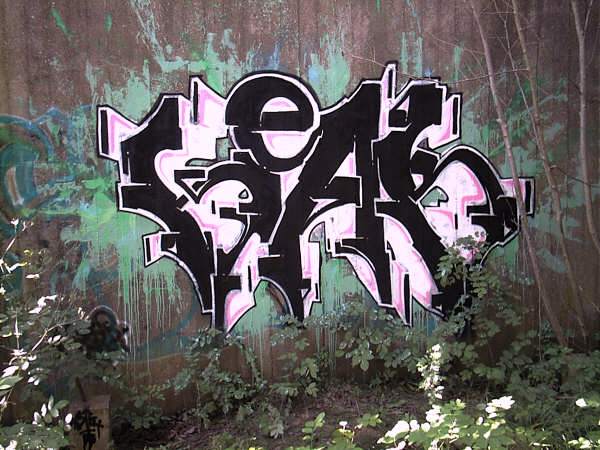
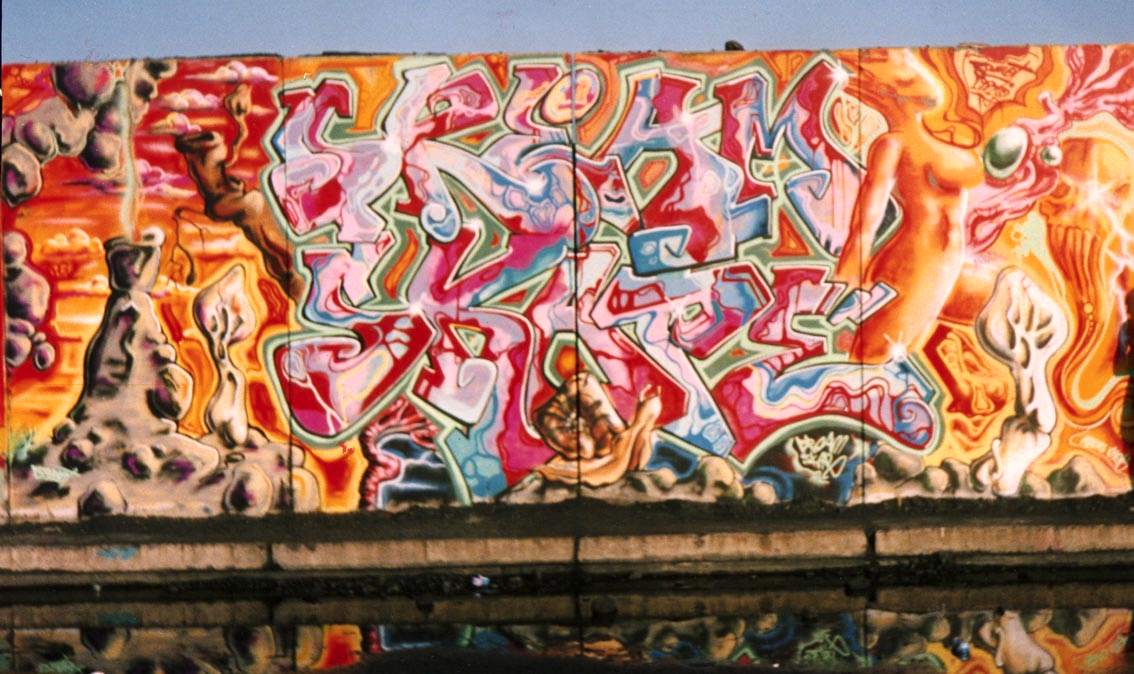
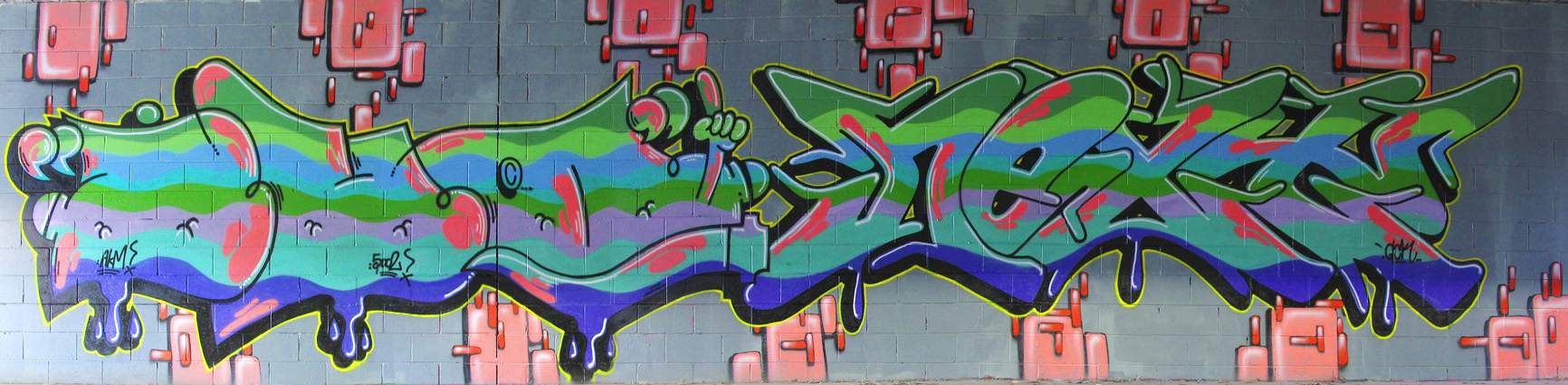
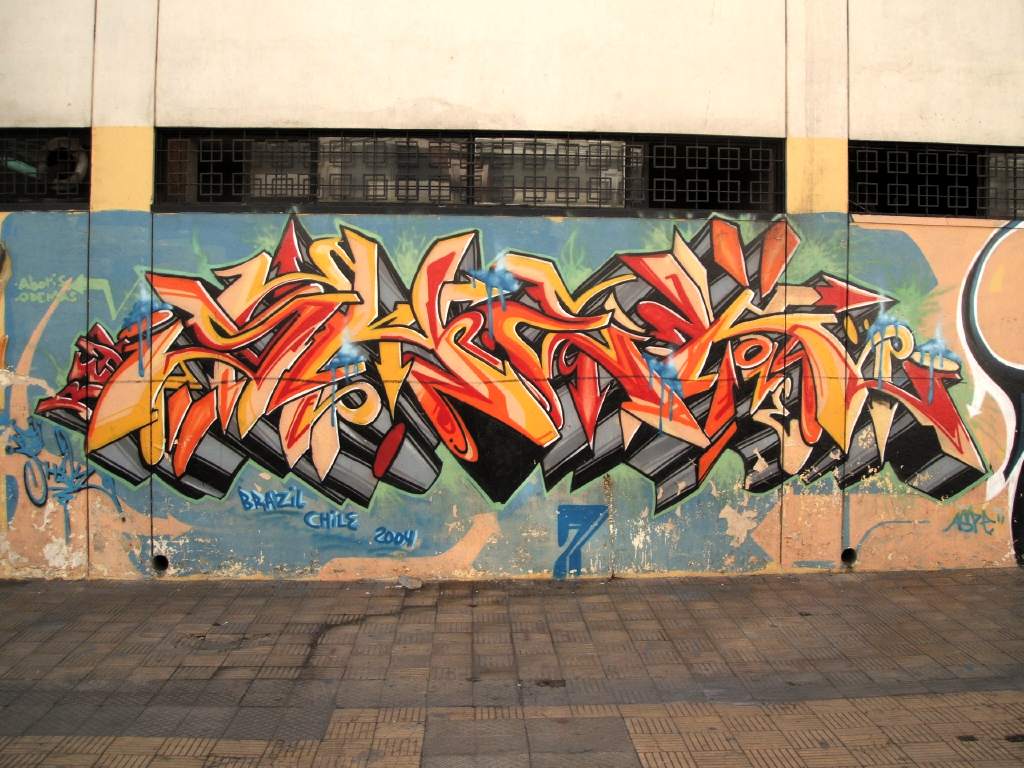
Graffiti has always been a big interest of mine, as I am an artist and I find the idea of stylized writing or "flow" very intriguing. Just like a rapper must go with the flow in his lyrics, a graffiti artist must create a visual piece which fits together as a whole. Graffiti styles often have very complex interwoven characters, colors, styles and shapes.
Urban graffiti is a form of expression which came from the Bronx and quickly spread throughout the world. I think most people see graffiti as a form of decay, however I think in many ways it serves as inspiration for other graffiti writers, DJ's or MC's. Originally, writing your 'tag' on the wall was a way to increase street rep and fame, and that quickly gave birth to a whole array of styles of graffiti. Afterwards it became a way to express your inner style in a very diverse way, to allow the listener to groove on what they hear (the music) and what they see (the graffiti).
I think in a similar way that MC's try to outdo eachother in hip-hop battles, graffiti artists try to outdo each other in terms of style. Tags are often painted over previous ones, and I constantly see more complex styles emerging all the time.

Aesthetics of Music


I was watching a film on TV the other day called Garage Days (2002). It is an Australian film directed by Alex Proyas about a garage band trying to get their big break in the music industry but unfortunately they sucked (to quote the tagline of the film). While the narrative of the film was not the best that I have seen, I thought what it showed was the different aesthetics within the music industry. After talking about Punk and Hip Hop aesthetics in the past 2 weeks I saw similar elements in Garage Days. The band members had a combination of differing aesthetics ranging from; the typical boy next door to the rock chick to the punk rocker. All the styles of the band members are not what could be called hard core but rather softened in what could be an attempt to appeal to the majority of the audience. Also the film did not have much ‘live’ music which made me wonder how you are meant know what music genre the band fits into when you don’t hear them play and when there is a combination of music styles represented within the band. Maybe the point of the various aesthetics was to work with the narrative that the band sucked as a way to suggest that the band member’s styles do not fit together and should not be combined into a band.

Jean Baudrillar and simulation

When I read the work of French theorist Jean Baudrillard, “simulacra and simulation”, I think it can be understood as star system, the simulation of MTVs is trying to let audiences feel with the singers, and the aura, which is created in the video, define the style of the singer. And it can be observed that the star is simulacrum, the styles and visualizations of the star is created through the MTV.
Madonna is a really good example to show Baudrillard’s idea of the simulation. She is a really important and famous star in the America, and in her music videos, the producers want to give audience an idea that is not only who is Madonna, but who is she represent for. And, in fact, her music videos are usually signifier strength of women, independent and confidence of female. The simulation of one of the music videos, which is called “American life”, is published during the “Iraq War”, and because her “American life” album is asking for peace and equal, in the MTV, she wears a service uniform and there are different countries’ national flag and different races of people showing in that MTV.

Stupid Girls


The hypersexual personas of female celebrities have become a part of pop cultural icon and it encourages, female viewers, especially those who are young, to pursue the glamour in appearance rather than social value of each individual. Directed by Dave Meyers, the music video Stupid Girls deals with the implied narrative by showing Pink as an angel as well as a demon who tries to persuade a young girl who is sitting on a couch having control of the TV remote. She is now directly exposed to visual media and the viewers can empathise with how effectively TV is influencing children when she follows the teacher’s move, flipping her hair back lightly, from TV. The clear depiction of an explicit narrative is also noticeable within the video Stupid Girls. The use of intertextuality may illustrate current the tendency by Pink to parody certain female celebrities who put excessive importance in appearance. For example, the scene where redheaded Pink hits pedestrians with her car is a negative portrayal of Lindsay Lohan. Also, the scene where Pink is dancing in a bikini while car washing evokes the viewer of Jessica Simpson’s music video “These Boots Are Made For Walking”. This is significant because it heavily emphasises the stupidity of the stars yet they are widely aspired by teenage girls.

The lyrics of the song are good match with the image and this forces the audience’s attention on the meaning of the words and makes idea more memorable. Whenever there comes the verbal hook, the ‘stupid girls’, Pink appears with a funny face but in fancy dress. She looks so trendy and fashionable with her costumes but her action is exaggerated to emphasis the stupidity of the people she refers to and this adds an extra fun to the video. For example, when the line “she's dancing in the video next to 50 Cent” comes, the viewers see Pink, dressed in like a typical Hip Hop ‘Booty Dancer’, actually dancing right beside a guy who just looks like 50 Cent. In addition, when Pink gets into the pet shop and picks up a small dog, there comes the line of “they travel in packs of two or three with their itsy bitsy doggies and their teeny-weeny tees”. Each scene is in fast-tempo, not only to match with the lyrics but also to keep a natural rhythmic flow of the song, as well as to maintain certain humour such as making funs of female stars whose works or videos or movies are popular.

Video Snacking: To Snack or Not to Snack?

I saw an article on One News this week about the recent development of special mini-movies made specifically for mobile phones. Yes, that's right, they are making little pointless videos with little to no audio element for us supposed Generation Y-ers who are apparently just so busy flitting from one media to the next in our fast paced world of minimal personal contact and have no time to look up from our teeny little mobile phone screens onto which our thumbs are apparently permanently attached. They think that we are actually that shallow, and that socially-retarded that our source of entertainment has been stunted and compacted down into a 3-5 minute basically silent and basically stupid video of a cat playing with a ball of twine or something equally as senseless.


I, for one, personally despise the hasty assumption that every one 25 years and under these days is some sort of isolated, incoherent, media-savvy yet romantically and socially deprived media critic who is constantly attached to a mobile phone, laptop and iPod. It's not that I'm not media-savvy, I think some of the gadgets out there are absolutely fascinating and just plain cool. But I definitely disagree strongly (for want of a better phrase) with this stereotype, and think the concept of "video snacking" as they call it is simply another outlet for the commercialism that pervades our very existence. I struggle to see any normal person benefitting from watching a "mobile phone movie" on the bus on the way to work etc. I mean, if i want to watch a cat play with a ball of twine(?), excuse my American - string, I will throw one at my own cat and watch it rivettingly unfold before me. Perhaps the news, or stock markets or something like that would actually be beneficial. Is it not bastardising the whole movie and audio-visual industry? I'd love to know what anyone else thinks about this concept. I'd also be interested to see if anyone in the class actually has snacked on such videos - and is brave enought to admit it.


Excuse the clumsiness of this post, passion got the better of me..

Chris Rock on Rap Music and Hip Hop Culture

I never used to be a fan of Chris Rock - in fact I didn't really rate him at all as a comedian until I stumbled onto a couple of his stand up acts about a month or so ago. I find Chris Rock interesting because of the way he uses controversial topics (like racism, drugs, abortion, the war on terror, etc.) to force people into thinking about those issues in a different way or even just to think about them in the first place. In particular after reading the Greg Tate article in the course book I was reminded of Chris Rock's segment on Rap Music and Hip Hop Culture.

Basically Rock talks about how rap music has become so hard to defend today compared to the days of Run DMC and Grand Master Flash when there was an intellectual basis to it and it could be considered a type of art form. Nowadays it's as if any lyrics can be put into a rap song and it will gain popular appeal no matter how misogynistic or offensive they maybe - see what he says about Lil John's 'Get Low'. I'm not sure whether this is due to the fact that we've become a society that just doesn't care anymore or if it is because we have become so used to seeing Hip Hop in the mainstream as some kind of glorified and glamorous movement that we are able to rationalize it as being something that is acceptable.

Rock also talks about the culture of Hip Hop music in terms the 'martyrs' of the rap world Tupac and Biggie Smalls. Both of these men have become such huge icons in the Hip Hop world to the point that there are still music videos today which either refer to them through lyrics of through the images. The fact that both of them were a part of the 'East Coast - West Coast hip-hop rivalry' and the type of gun totting gang culture surrounding it is often dismissed or made to seem like it is in some way "cool".

Rock's segment and the Tate article have made me question exactly what Hip Hop is today and how exactly did it go from being an intellectual art form that was a part of folk culture to the homogenised, shallow and over commercialised form that it is today? As Tate says Hip Hop as we know it today would be nothing with out money and it has moved from being a means to express ones disenchantment with the status quo to being a means to reinforce it through the association with everything from high fashion to street wear, Hollywood to the hood, Alcohol or drugs to soft drinks and you can't forget the iconization of pimps, ho's and bling - the ubiquity of Hip Hop as a commodity has secured its place as a part of the capital market place and it isn't going to change anytime soon.

I don't think that comedian's like Chris Rock are going to be able to change anything about the way Hip Hop influences us today but I do think in some ways he is spreading an awareness of the fact that it has completely changed from it's folk culture beginnings and not in a good way. As enjoyable as it may be for someone to dance in a club to Lil John's 'Get Low' or some other modern Hip Hop song when you actually take a minute to listen to the lyrics there has to be some kind of a realisation that something isn't quite right with the image being presented to us. The question is more are we willing to do anything about it or are we going to just continue to reinforce the status quo?

WARNING: This video contains foul language and offensive content.

The Rev. has spoken, bitch.


Al Sharpton, Pentecostal minister and civil rights activist, has teamed up with hip-hop pioneer Russell Simmons (or Run from Run DMC) to pressure the music industry into ‘cleaning up’ hip-hop and rap music and protesting for a ban on using misogynistic words in song lyrics.

The duo has united in the wake of the Don Imus incident in which his morning radio show was cancelled after he referred to the Rutgers Woman’s Basketball team as ‘nappy-headed hos’.

I think the issue of censorship is interesting for a variety of reasons, namely what this would mean for the way hip-hop and rap music is currently packaged, and also how this regulation will translate to other genres and mediums.

However, it seems that the misogyny Sharpton and Simmons are fighting against is in fact what comprises hip-hop and rap as a culture today. Women are commodified and portrayed as sex objects and this behaviour is normalised by song lyrics and music videos.

It can be argued that these genres simply reflect the current attitude of contemporary society, but I think it is more the case that the support of significant financial investment by record labels and the way in which hip-hop and rap aesthetics and culture has been utilised in advertising has helped to acclimatise audiences to this particular position on gender. This is largely driven, I think, by the influence of MTV and the music industry’s desire to cash in on a profitable market.


Ultimately though, I think that some form of regulation may work towards giving back a level of respect and agency to women that is currently lacking in hip-hop and rap music today. Hopefully by re-thinking the codes and conventions of these genres, Sharpton and Simmons may bring about a revival of hip-hop and rap music as a once more meaningful voice of social commentary.

Glam rock is all about the meat

Recently Vodafone has been airing an advertisement for their new Vodafone world - a world of limitless oportunities, where the sun shines and dogs catch frisbies and lovers stroll hand in hand. The soundtrack is a soundbite of the song 1970's "Another Girl, Another Planet" by the only ones. I adore this song, and have personal conotations with it. But I now have a horrible sense of commercial product identity when I play Another Girl, Another Planet at home. Instead of the memories and ideas that the song conjures up, Vodafones slogan "Make the most of now!" springs into my head. Basically, the ad has nearly ruined the song for me. Interestingly, the optimistic ad concerns idealistic worlds that YOU can create with vodafone. Some of the (depressing?lyrics of the song are
I always flirt with death
I could kill, but I don't care about it
I can face your threats Stand up tall and scream and shout about it
I think I'm on another world with you
I'm on another planet with you

In the uk, the song is the on hold music when users call up to discuss their plan/account information.
My point is, is that big compaines have now made claims on songs.
Some examples:
*Beach Boys Wouldn't it be nice is now linked to a chocolate world where chocolate people buy Cadbury chocolate.
*Glam rock apparantly is all about meat. T-Rex's We love to boogie now promotes new zealand beef
*The exponants - Why does love do this to me has been on recent Air New Zealand commercials
*New Radicals - You've got the music in you - Every car company ever to have made cars anywhere in the world
*Jose Gonzalez's cover of Heartbeats - the add with the bouncy balls was used in a sony commercial
*And most recently Regina Spektor's fidelity has been used in Yahoo Xtra commercials.

How much must artists receive in order to give intellectual connotation property of their songs to big companies/conglomerates. And is it a good or bad thing? The good side of course, is that more people can hear musicians/songs. But the bad side, is the song will (arguably) always be attatched to a product. The song can easily be killed. The artist can be seen as "selling out". Overlyprecious fans (ie. me?) are likely to feel cheated that an artist who they've held with much respect concerning their lack of selling out. Although, in saying that, I'll always love The Only Ones, and I'll Always love the song. And it brings back good memories of my past each time the advertisement comes on. But it's definately made me think all about advertising and music. It can be quite interesting to watch tv and see if you recognise songs.

MTV's 'ROCKBAND' Game

MTV has just announced the development of a new game for Xbox 360 and Playstation three called 'Rockband'. Following on from the huge success of Sony's 'Singstar' Karaoke games and other musical games such as the currently number one in the states 'Guitar Hero' series, the game will ship with a variety of different instruments such as a guitar, drums, bass and microphone and allow music fans the ability to play their favourite songs without having to learn the real instrument.

What is really exciting about the development is the ability to form an band with friends from the net and play in real time online and even put on performances for spectators to view. Containing music from all of todays top artists it also features official licenses from equipment manufacturers such as Fender to add to the authenticity.

The demand for music based games has spawned some really fun and interesting products on home consoles and this game, taking advantage of now standard broadband connections, looks to be the one to really take this genre to the next level.

If you are into music video games such as DDR, GH and Singstar this could be what you've been waiting for. It's scheduled to release Christmas this year.

ww.rockbandgame.com

Rebirth of hip hop culture

When we indicate “hip-hop culture”, we includes MCing, DJing, Break dancing and graffiti. Hip-hop is initiated in USA but the globalisation of hip-hop rapidly increases hip-hopers all over the world. Globalisation of hip-hop do not only refers imitating the technique and sprit of USA, but also re-establishing and evaluating hip-hop on their own ways and own culture. Break dancing is pioneered in New York City in early 1970s as a street dance among black people. B-boy stands for male break dancers. When break dancing introduced in Korea there wasn’t any remarkable spot until 1990. However, they have started to won the first place in most of the international competitions such as ‘Battle of the year’ in Germany, ‘UK b-boy championship’, ‘Free-style session’ in USA and ‘Red bull BC ONE’. Korean b-boys are well known among other b-boy crews and break-dancing loves internationally. Although, break-dancing is not a Korean culture, it seems that Korea has swept over the whole world with b-boying. People come to Korea and study Korean to learn techniques of break-dancing. It is overwhelming for me that such popular dance has a crucial role to introduce Korean culture to the world. Representative Korean b-boy teams are ‘Expression’, ‘Gambler’ and ‘last for one’. Notably, ‘Gambler’ has been invited to perform their dance at the opening show of the Beijing Olympic Games in 2008. Globalisation of one’s culture can transform the culture and it can be even developed in a good way. Now hip-hop is a world –wide popular music and it is made and sung in everywhere. During the process of globalisation, people do not only accept the hip hop music but the culture and the spirit. When they combined hip hop culture and their national culture together, they make a new genre of hip hop and it might affect to the original hip hop too. Circulation of hip hop culture is also a circulation of national culture.

Rebirth of hip hop culture

When we indicate “hip-hop culture”, we includes MCing, DJing, Break dancing and graffiti. Hip-hop is initiated in USA but the globalisation of hip-hop rapidly increases hip-hopers all over the world. Globalisation of hip-hop do not only refers imitating the technique and sprit of USA, but also re-establishing and evaluating hip-hop on their own ways and own culture. Break dancing is pioneered in New York City in early 1970s as a street dance among black people. B-boy stands for male break dancers. When break dancing introduced in Korea there wasn’t any remarkable spot until 1990. However, they have started to won the first place in most of the international competitions such as ‘Battle of the year’ in Germany, ‘UK b-boy championship’, ‘Free-style session’ in USA and ‘Red bull BC ONE’. Korean b-boys are well known among other b-boy crews and break-dancing loves internationally. Although, break-dancing is not a Korean culture, it seems that Korea has swept over the whole world with b-boying. People come to Korea and study Korean to learn techniques of break-dancing. It is overwhelming for me that such popular dance has a crucial role to introduce Korean culture to the world. Representative Korean b-boy teams are ‘Expression’, ‘Gambler’ and ‘last for one’. Notably, ‘Gambler’ has been invited to perform their dance at the opening show of the Beijing Olympic Games in 2008. Globalisation of one’s culture can transform the culture and it can be even developed in a good way. Now hip-hop is a world –wide popular music and it is made and sung in everywhere. During the process of globalisation, people do not only accept the hip hop music but the culture and the spirit. When they combined hip hop culture and their national culture together, they make a new genre of hip hop and it might affect to the original hip hop too. Circulation of hip hop culture is also a circulation of national culture.

Pure madness or pure genius?

Baz Luhrmann is a fascinating director. I’ve found when it comes to his films that you either love him or you hate him. William Shakespeare’s Romeo + Juliet (1996) and Moulin Rouge (2001) are two films that are of great importance to my top ten list and I love debating with friends who may despise Luhrmann, for the way in which they bond historically-based narrative and modern popular culture society. The soundtrack to both films is especially supportive of this fact. Where else would you find Leonardo DiCaprio quoting some of the most famous lines in English literature backed by a Prince song? Where else would you hear Ewan McGregor serenading Nicole Kidman with an opera-mixed version of “Smells like Teen Spirit”? The answer is: only in a Luhrmann film. What makes the mix work? Or for that matter, why do some hate it completely? With Romeo + Juliet, Luhrmann channels teen angst, honing in the conflict between the young lovers and the society that controls them. British rock band Radiohead penned the closing titles song which is a sharp and haunting song that echoes the tone of the film and the tragedy of the classic love story in a dark and disturbing stab at society:

Wake from your sleep, the drying of your tears, Today we escape, we escape.
Pack and get dressedbefore your father hears us, before all hell breaks loose.
Breathe, keep breathing, don't lose your nerve.
Breathe, keep breathing, I can't do this alone.
Sing us a song, a song to keep us warm, there's such a chill, such a chill.
And you can laugh a spineless laugh, we hope your rules and wisdom choke you.
And now we are one in everlasting peace,we hope that you choke, that you choke.

In a world of gun-toting teens and over-protective, yet completely oblivious parents, Luhrmann takes the classic story and turns it on its head as the society in which the character’s live is modern, yet unfamiliar. This is translated through the songs on the soundtrack as well, for instance the way in which Prince’s classic “When Doves Cry” is performed by the chorus of a Catholic church. A pretty strange combination of art and religion that is ironically modern, yet strangely disconcerting. This captures the aura of the whole film and in my opinion heightens the strength and impact of the love story for the next generation. Many people whom I’ve introduced this film to say that if they didn’t understand Shakespeare before, they do now. It just works, and Luhrmann elevates that status in Moulin Rouge by incorporating modern songs by such artists as Elton John and Madonna into his musical period piece, that is also the simple tale of doomed lovers. Craig Armstrong is a masterful musical composer who remixed all the songs of Moulin Rouge, capturing the aroma and feeling of the era but with the lyrics of popular songs from the 80’s and 90’s. It’s everything from the glitz and glamour of the costumes and sets to the eccentricity and shear loudness of each and every musical number that hits at the heart of the films conscious; the visual and aural spectacle are used specifically to overshadow the simplicity of the love story. I think it works, do you?

Am I Enid? Transferrence in the world of collecting

What’s your most prized possession? Is it something that you keep with you all the time, or something that is locked away in a box in your closet that only sees the light of day when you really need it? Personally, mine is my DVD collection (319 and counting) that fits nicely into an oversized CD case, convenient for carting anywhere, as I brought it here to NZ from the United States. It’s important to me, not just because it’s cost me thousands of dollars to compile, but also there’s just something about having it, owning it, and showing it off that I really love. It’s organized by genre, but mostly in genres I’ve made up myself (i.e. disgruntled animals = Jurassic Park, Jaws, King Kong), and then by the design on the disk itself. Every now and then I take everything out and reorganize it, but that is a rare occasion when I’m incredibly out-of-my-mind bored. Sometimes I can flip through the whole thing and not find a single movie I want to watch, but simply find pleasure in looking at them all. Other times I can just flip directly to a certain page and fish out what I want to watch based on my mood. The point is, I feel like I have a similar relationship to my DVD’s that characters such as Enid in Ghost World and the Lisbon sisters in The Virgin Suicides have with their records. While reading the articles by Robertson-Wojcik and Stilwell I got the feeling I was reading about myself. Ironically enough, my best friend Casey has a larger DVD collection then me and we compete to push each other to buy more movies and then watch each others’. His collection is scattered, each DVD in its original case and spread out between his living room, bedroom and other people’s houses. But he has a record of each movie listed on his computer that he updates every time he makes a new purchase. I’m precise and organized and fuel my love of movies in my purchases that display all sides of my personality, where each film has a special meaning to me; Casey collects for sport, he buys in bulk and is happy with watching the same movie over and over again after he’s bought it until he gets sick of it and disregards it to the corner of his floor. Together, we are the perfect male and female real-life representations of the record collectors talked about in both articles and seen in numerous films.

Elton John meets Krumping

This week’s lecture on hip-hop got me thinking about a documentary I saw last year called “Rize”. The film highlights two relatively new dancing sub-cultures of Los Angeles: Clowning and Krumping. In particular, the film’s final song “Ghetto Gospel” by Tupac seems (in light of the lecture) more symbolic.

Hip-hop, after all, originated from the urban African American community. In the decades since it has become ‘mainstream’ (in that it is now widely recognized, socially accepted and commended). “Ghetto Gospel” reflects this acceptance: Tupac represents a traditional hip-hop artist (in this case a rapper), however the song also features Elton John. Elton’s involvement reflects the acceptance and appreciation of hip-hop on a number of levels. Firstly and most simply, as a Caucasian artist he symbolizes the way in which hip-hop has crossed racial boundaries (further evidenced by the fact the song is produced by Eminem). In fact, Elton John (at 60) is a musical icon to multiple generations and is a veteran of the music industry. In embracing hip-hop he is reflecting the way in which the industry itself, and multiple generations, have begun to embrace hip-hop.

With that in mind, the song’s placement at the end of “Rize” seems more deliberate. As mentioned, Clowning and Krumping are relatively new dance subcultures that are still gaining acceptance and recognition. In this sense, they are analogous to hip-hop in its early days. They are largely African American subcultures and few outside of these subcultures fully understand or appreciate the skills involved.

Thus “Ghetto Gospel” provides a snapshot of the success these dance-forms could enjoy. Through the song, the film ends with a sense of hope a sense of hope, as the song is proof that art-forms can be born in disadvantaged or minority areas and nonetheless become incredibly popular and accepted.

Hip Hop: the face of black America

One of the weeks readings for the week dealt with issues surrounding the Hip Hop genre as it is celebrating its thirtieth year. Greg Tate considers the way Hip Hop has evolved and changed since it began as an isolated folk culture in Brooklyn and the Bronx. Tate argues for the contradictory nature of todays Hip Hop when comparing it to what the genre stood for when it first developed. Writers such as Tate agree that while Hip Hop still represents Black culture, they are skeptical as to whether hip hop today is still a cultural force or a manufacturing plant for the entertinment industry. They suggest that Hip Hop has developed a novel character as it has entered into the mainstream and secured a place in the global econmy. Tate considers how since the emergence of Hip Hop alot of the power of the genre and all it stood for has been lost as it has been recognised as an opportunity for capital gain. Its emergence was founded on the socioeconomic caste of black people in America and played a significant role in the Black cultural reawakening in the 80's. Hip hops origins are located as part of a political dynamo, a foundation which is unobvious in the representations of Hip hop culture we see today. Today we see the just how commodified the genre has become from signature sneakers to P diddy signing up with Estee Lauder. Although Hip hop has played a positive role in civil rights in the past, the genre has transformed itself from the art form from which it began as the lure of global hyper capitalism appears to have been too strong.

Commercialisation of Hip Hop Culture

The commercialisation of hip hop music and culture since the movements inception in the 1970s has been a massive transformation. Seen as an underground movement in the seventies and early eighties, it is hard to believe advertisers and MTV executives were concerned about linking their products with hip hop. The association of Run DMC with Adidas, Kurtis Blow with Coke and the Fresh Prince with Mountain Dew in the mid eighties has paved the way for the multi million dollar industry that surrounds Hip Hop today. Ice T and Flava Flav have reality tv shows, Snoop Dogg features in video games, Puff Daddy sells purfume, clothes and many rap stars such as 50 Cent have crossed over into film, selling themselves and their images as a commodity. Hip hop aesthetics have made the cross over as well and are commonly used in advertising. In just a few decades hip hop has become arguably the most lucritive music genre for advertising.

Anna

What Will Happen To Hip Hop?

Before going through the readings on Hip Hop, i had no idea about its multi cultural origins. I was also surprised to find out that it was originally created by 'real people' of the public rather than the media/corporations (although the media and corporations are obviously the driving force behind hip hop and what it is today). What amazes me about these articles in the reader, is that they demonstrate how much of an influence 'big money' and the media can have on the public. The media with its viralistic tendencies can make one think, feel and believe any thing about any group of people, country, event, product and even oneself. It is sad and disappointing that hip hop has been commodifed with it now being possible to buy the hip hop look with baggy clothes, hats, shoes and all the accessories and attitudes that go along with it. The thought of hip hop's future is quite interesting. I think the 'truth' about hip hop and how it has evolved into what it is today, is becoming more widely realised in the public relm and i wonder if there is a possibility that there could be a hip hop revolution and some of the original/ traditional aspect of hip hop may return. There may be a move in the lyrics and topics discussed in hip hop, more racial groups and minority groups who where involved in the 'creation' of hip hop may become more visible and active in the media????? Or that could be completely wrong, hip hop could completely die away and go out of fashion, or it may continue down the African Americanised path, excluding other racial groups and continue to rap about 'bitches' and 'hoes' and shoes, and dance moves (or shoulder leans)???????

Re-consuming 'old' Music

I have noticed that in recent years that older songs and artists are re-consumed through the latest films and shows. Music artists like Elton John, David Bowie, Johnny Cash, Ray Charles, The Supremes and The Beatles have appeared more popular since certain directors have included these artist's songs in their films or have made biographical films about them. Baz Luhrman's Moulin Rouge was a musical that had Ewan McGregor and Nicole Kidman singing songs that had once been popular in the past. they sang: 'All You Need Is Love" by The Beatles, 'Heroes' and 'Diamond Dogs' by David Bowie, 'Like A Virgin' by Madonna, as well as 'Your Song' by Elton John just to name a few. With the popularity of the film and the soundtrack these songs also had become re-consumated and had somehow gave these artists another chance in the limelight of fame. The re-consumption of vintage music has also been mediated through the biographical films about the musician's life and music. The films 'Walk the Line', 'Ray' and 'Dreamgirls' allowed the youth of present day to recognise Johnny Cash, Ray Charles and The Supremes and their music in appreciation. Therefore, these film have also contributed in the sales of these artist's larger record sales that usually accompanies a Greatest Hits album.

Graffiti

Personally, I love graffiti. I think its a vibrant and creative art form. I dislike the fact that graffiti is seen as vandalism. Companies like "Graffiti-Busters" are popping up and portraying graffiti as a pest to be exterminated. I can understand why people get pissed off with taggers... there's a difference between a work of art and a scribbly tag over someone's freshly painted white fence. But the problem is that graffiti artists have to start somewhere. They need practice to develop their artistic talent. But no matter where its done, its bound to annoy someone.

In about 2003 I picked up the first issue of Disrupt magazine which is full of photos of New Zealand graffiti. This, and the opening of the Disrupt gallery on K road (and now a second in Grey Lynn called Gallery With No Name that just opened on the 11th of May) gives a place for graffiti to be showcased. On their website ( http://www.disruptiv.com/) they advertise shows where graffiti art is practiced, have galleries of commissioned works, and sell graffiti art on canvas. This all gives not only inspiration for aspiring graffiti artists, but also direction.

Disrupt don't just show professional graffiti though. The disclaimer on the first page of their magazine reads; "We do not support vandalism but it is our intention to show an unbiased cross-section of art on the streets of New Zealand." This honest approach is appropriate for a fairly un-institutionalised art scene and leaves opportunities open for amateur as well as expert graffiti artists. This is good because I think something would be lost if all graffiti was sold or used to advertise. It would lose the use of urban space that is part of hip hop culture. There's something fun about tags in public space. I love seeing graffiti in hard-to-get-to places like on the side of a tall building; I think of that person who has gone on a mission up an old rickety ladder, or climbed over concrete piles to put that graffiti there. I also think that the temporality of it is an interesting factor. Graffiti literally appears overnight, and it is only a matter of time before it is either removed, or tagged over by someone else. It reflects the idea that hip hop is constantly changing and is a reason why graffiti is such a lively art form.

Oprah vs Hip Hop

An interesting element to the Hip Hop as African American empowerment, verse Hip Hop as a social reckoning debate, has been the public debate surrounding Oprah. It has been speculated for several years now as to whether Oprah is against Hip Hop rappers or not. Although she has come out publicly saying that she does like some Hip Hop and even has some on her ipod, debate has continued due to the lack of rappers on her show. As an advocate for African American success it would seem logical that Oprah would be more than willing tell the success stories of young black men from disadvantaged backgrounds that had made it big through music. However clearly this is not the case. I would speculate that perhaps Oprah views this cultural trend as a negative force for African American identity. Hip Hop culture often idealizes the staunch masculine identity, valuing violence, aggression, crime and disrespect for women. With more African American men in jail than in college, it is little wonder that Oprah may not want to promote these ideals on her show.